
Category Archives: Articles

Bant Lands Evaluation

Introduction

I launched the Competitive Lands Project at the beginning of this year. It is designed to showcase Legacy Lands from a competitive perspective. You can learn more about this initiative via this article or this introduction video.
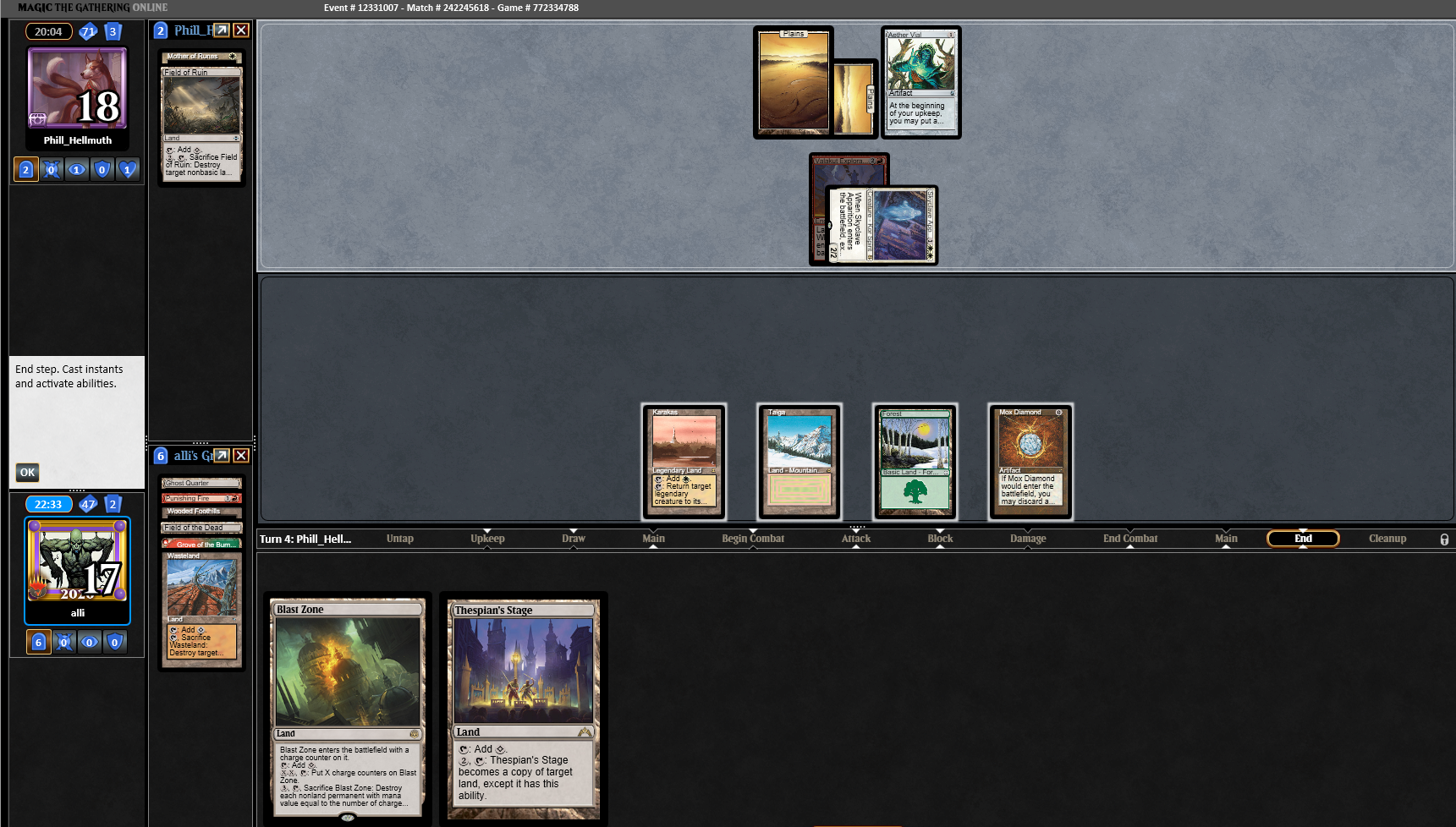
Season 1 is now complete and I focused on playing and tuning Bant Lands for the entire season. I have played the deck in 6 Prelims on MTGO and it’s now time to draw some conclusions. But before we start with that here are the hypotheses that I had when I started this season.

  • I was worried about playing against the Blue-Zenit deck with RG Lands and my hope was that Swords to Plowshares would help in this matchup.
  • I did not think that Planeswalkers would be popular and I was hoping that Constructs + Pithing Needle would be enough to combat walkers. Karn in particular felt horrible to play against but I was not predicting that card to be heavily played.
  • I did not think that I would miss Punishing Fire against the Tribal decks but this remained to be seen.
  • Flusterstorm is the only card that I can think of that is good against TES, Show & Tell and Doomsday, and I expected Bant Lands to be better against spell based combo decks.
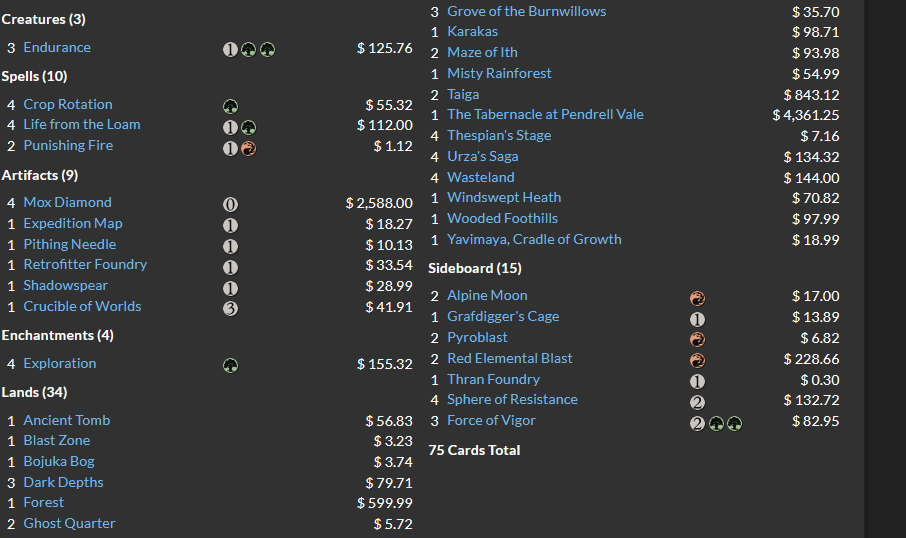
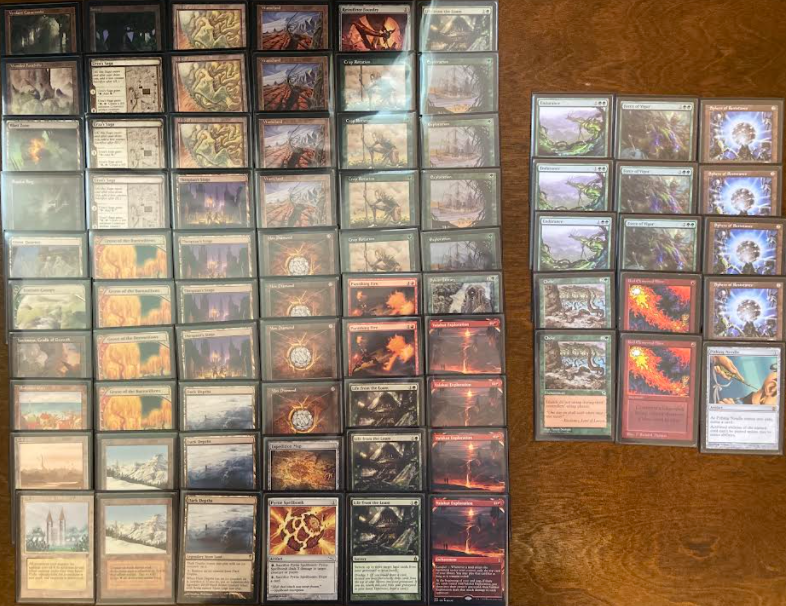
  • Elvish Reclaimer felt great in the meta but I did not think that I would have room for Urza’s Saga and Reclaimer in the same deck. For reference here are examples of my initial Bant Saga Lands and Bant Reclaimer Lands decklists.

My Results

I played 24 Legacy Prelim matches and won 19 of them. This is a win rate of +79%, against excellent opponents, and is way over my expectations. I am of course super happy with the result. I want to add a caveat to the metashare and winrates posted in this article as they are based on very small sample sizes. I don’t think that we can draw too many conclusions based on these numbers without also taking into account how the matchup felt when I played them. My deck did in fact feel strong against both fair and unfair matchups. I had a healthy mix of spell based and permanent based hate vs combo and when I had a good draw I felt almost unbeatable (even against hard matchups). 
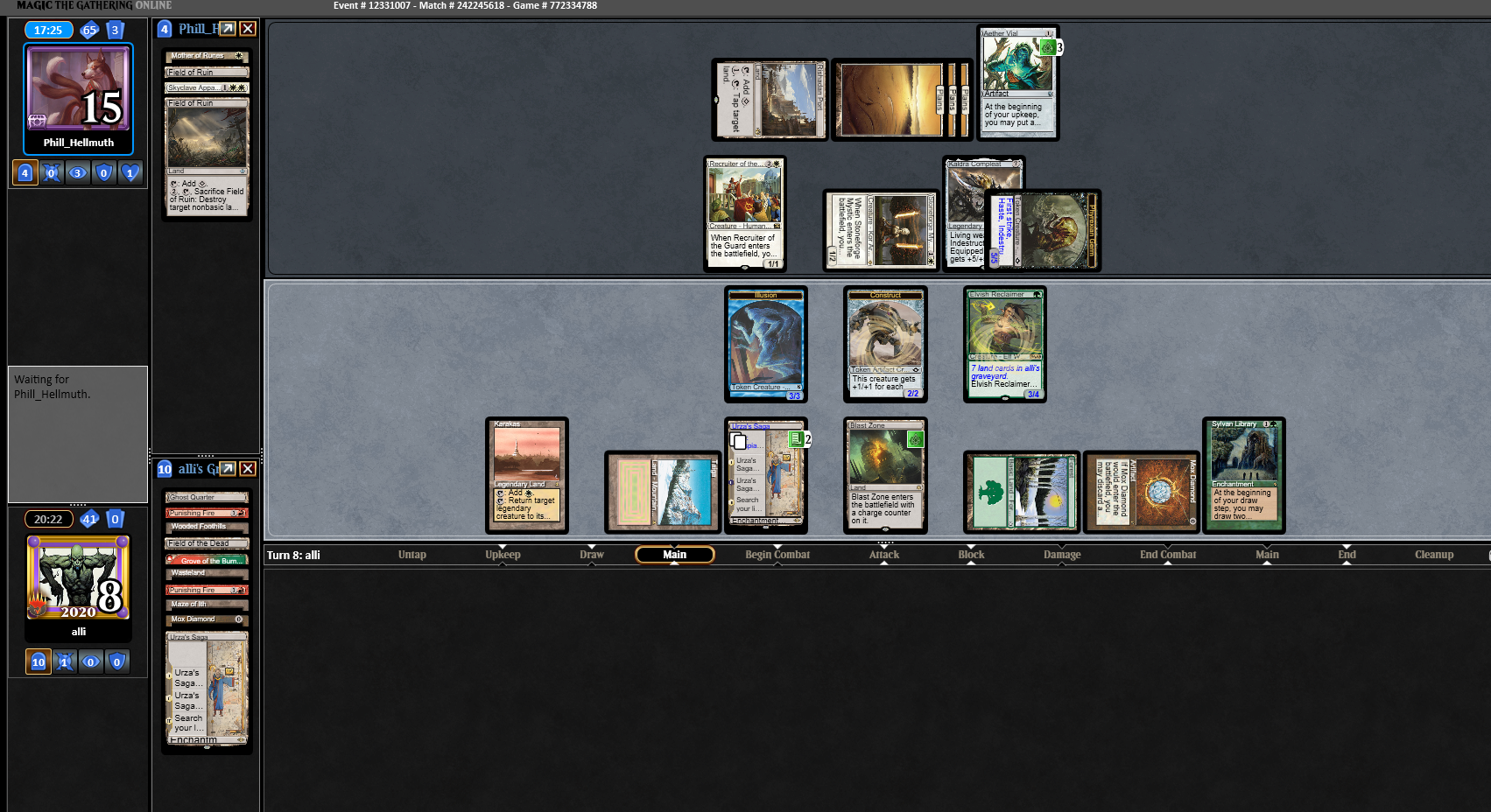
The table below shows my results split per archetype. It also shows the metashare that I expected vs the metashare that each archetype realized.

ArchetypeRealized MetaExpected MetaMy Score
Daze25%27%5-1 (83%)
Karn21%5%3-2 (60%)
Control17%21%3-1 (75%)
Graveyard13%14%2-1 (67%)
Depths8%4%2-0 (100%)
Dark Ritual8%6%2-0 (100%)
Brew8%2%2-0 (100%)
Tribal0%11%

Daze Decks

I expected Daze decks to be 27% of the winner’s meta and my prediction was spot on as I played against them in 25% of my matches. Bant Lands felt very strong vs the Daze decks (even stronger than RG Lands). My removal cost 1 mana so my deck is lean and this matchup is all about gaining a mana advantage. I am not going to write a detailed matchup guide here but I did write about Lands vs Delver before and, although that article is a bit old, the basic concepts and strategies still apply today.

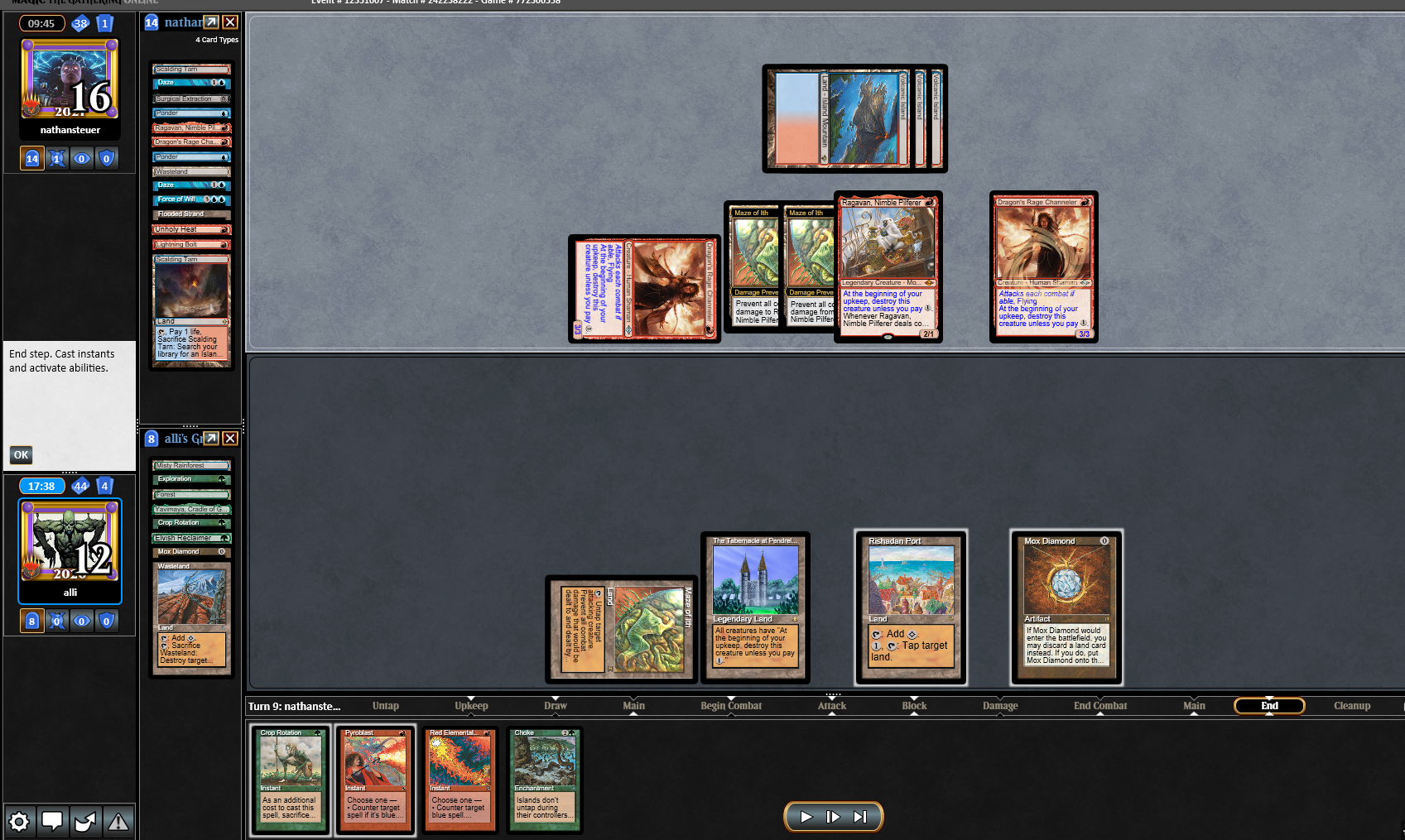
I went 4-1 against UR Delver and 1-0 against Jeskai Murktide to a combined winrate of 83%. I cannot really complain about that. My strategy in these matches was to try to stay ahead on mana and (when I could) play in a way so that I would not lose to Ragavan or Murktide. This went well and the only match that I ended up losing was when my opponent had Karakas for my Marit Lage in both game 2 and game 3.

Here are some quick notes on playing against UR Delver.

  • They have 0 answers to Marit Lage in the main and 3 answers in their sideboard (1 Karakas and 2 Submerge). This means that Marit Lage is very safe in G1 but it gets riskier in the post sideboard games.
  • Shadowspear is a game changer in this matchup and it completely takes over any kind of race. Shadowspear + Construct can often race even a Murktide.
  • It’s better to be proactive than reactive and this is why I like Elvish Reclaimer and Endurance so much in this matchup. Your opponent will have many cheap threats and just overloading on one for one removal is risky. Reclaimer can play defense but at the same time help us work towards a Marit Lage or Constructs + Shadowspear.
  • Their best cards are Ragavan, Wasteland and Murktide. Turn 1 Ragavan (blanks our Wastelands) into turn 2 Wasteland (blanks our Dark Depths and Saga) can make it difficult for us to win (especially if we are on the draw). Murktide kills in just a few turns and it can mice some wins for our opponent if they also have a timely Wasteland for our Maze of Ith.   


I only played against UR Delver once on camera and it can be found here.

Karn Decks

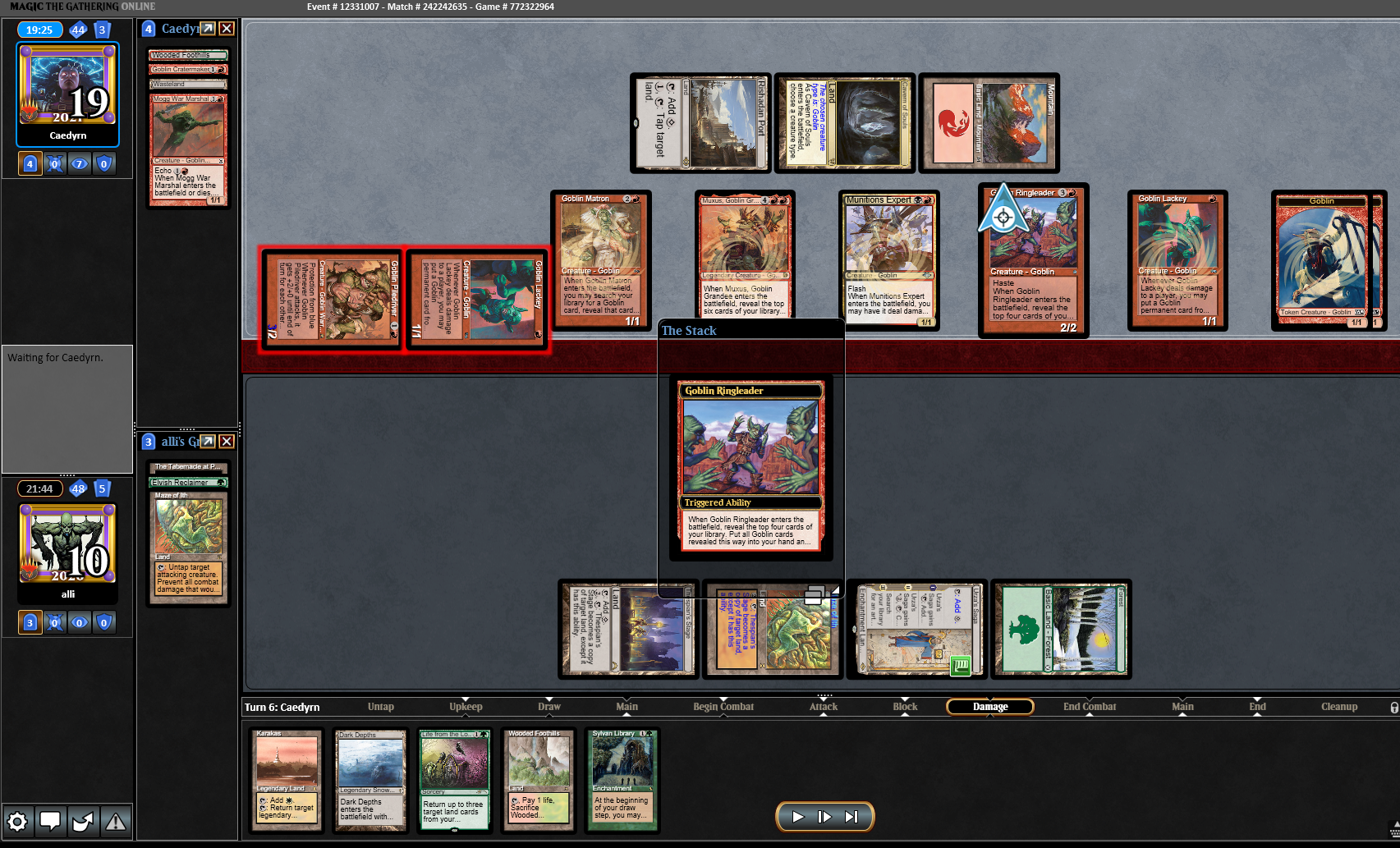
Going into this experiment I said that I wanted to “dodge” the Karn decks. I only expected Karn to take up around 5% of the winner’s meta and I thought that it would be very hard to beat a resolved Karn with Bant Lands. I ended up playing against Karn decks 21% of my matches so this prediction was completely off. Part of the reason that my prediction was so off is that I had labeled 8-Cast as Urza’s Saga instead of Karn going into this experiment. It turns out that 8-Cast decks have started playing Karn so that was a mislabelling from my side. But on top of this various blue Painter decks started popping up in January and these decks all played Karn.

I went 1-0 against 8-Cast, 1-0 against Bomberman and 1-1 against Painter and 0-1 against Mystic Forge. This gave me a combined record of 3-2 and actually a positive winrate against the matchup I wanted to dodge. It turns out the matchup is not as bad as I had feared. Here are some quick notes.

  • Needle on Karn makes these matchups alot easier and I will blind name Karn with my needles.
  • Shadowspear beats Sai, and Shadowspear is a big part of the reason why 8-Cast is a favored matchup when they don’t draw Karn.
  • Marit Lage can still mice some wins in 2022.  

I played against Karn decks 3 times on camera and you can find them here.

Control Decks

I expected Control decks to take up 17% of the winner’s meta and this prediction was a bit low as I ended up playing against Control in 21% of my matches. Going into this project I was fearing the Blue-Zenit deck, and this deck was in fact the contributing factor for me choosing to play white over red removal. It turns out that the Blue-Zenit deck is currently only the 3:rd popular Control deck online and the current split is something like 50% Uro Piles, 40% Jeskai Hullbreacher and 10% Blue-Zenit. Punishing Fire and Pyroblast seems very good against Jeskai Hullbreacher and it is not clear to me that Bant Lands is the best configuration for this meta. 

I am also not sure that Bant Saga Lands is actually favored vs Blue-Zenit. I played against McWinSauce on Omnath Pile (that is like Blue-Zenit on steroids) and it did not feel good. I only felt that I won the game where my hand was good and their hand was bad and this is not where I wanted to be vs blue control. Blue-Zenit gets a lot easier for a Lands list that is centered around Elvish Reclaimer, Flagstones and Uro though. It turns out that when we want to then we are the best ramp deck in Legacy, and I believe that my match against mei0024 in Episode 7 highlights this.

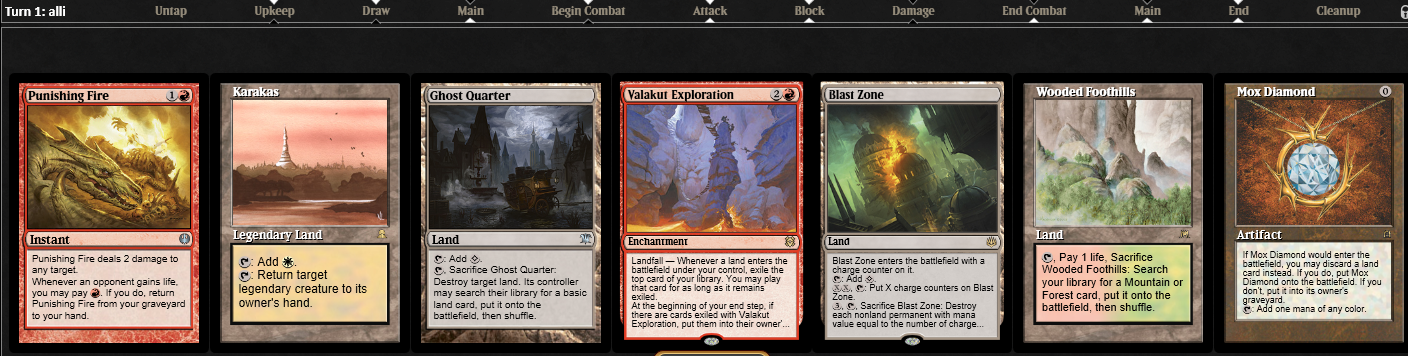
I went 3-1 vs the Control decks and this is a good result in my opinion. I feel that the Uro Piles are the easiest of the Control decks as they can have a real hard time killing me on time if I handle Uro. My overall strategy against Uro Piles is to get the Stage + Saga online and eventually find Karakas via an Expedition Map or Crop Rotation. They will now spend their cantrips and card draw looking for something like Dress Down. If they find it then the game goes and if they don’t find it then they lose. But even when they do find Dress Down they are still on a route to lose the match because now the entire match revolves around time and they will be behind on the clock as they have many more game actions to perform each turn. I think my match against Bant Control in Episode 2 shows this pretty well.

I played against Control decks 4 times on camera and you can find them here.

If you want to learn more about Lands vs Control then I recommend that you read my in-depth article about the matchup.

Graveyard Decks

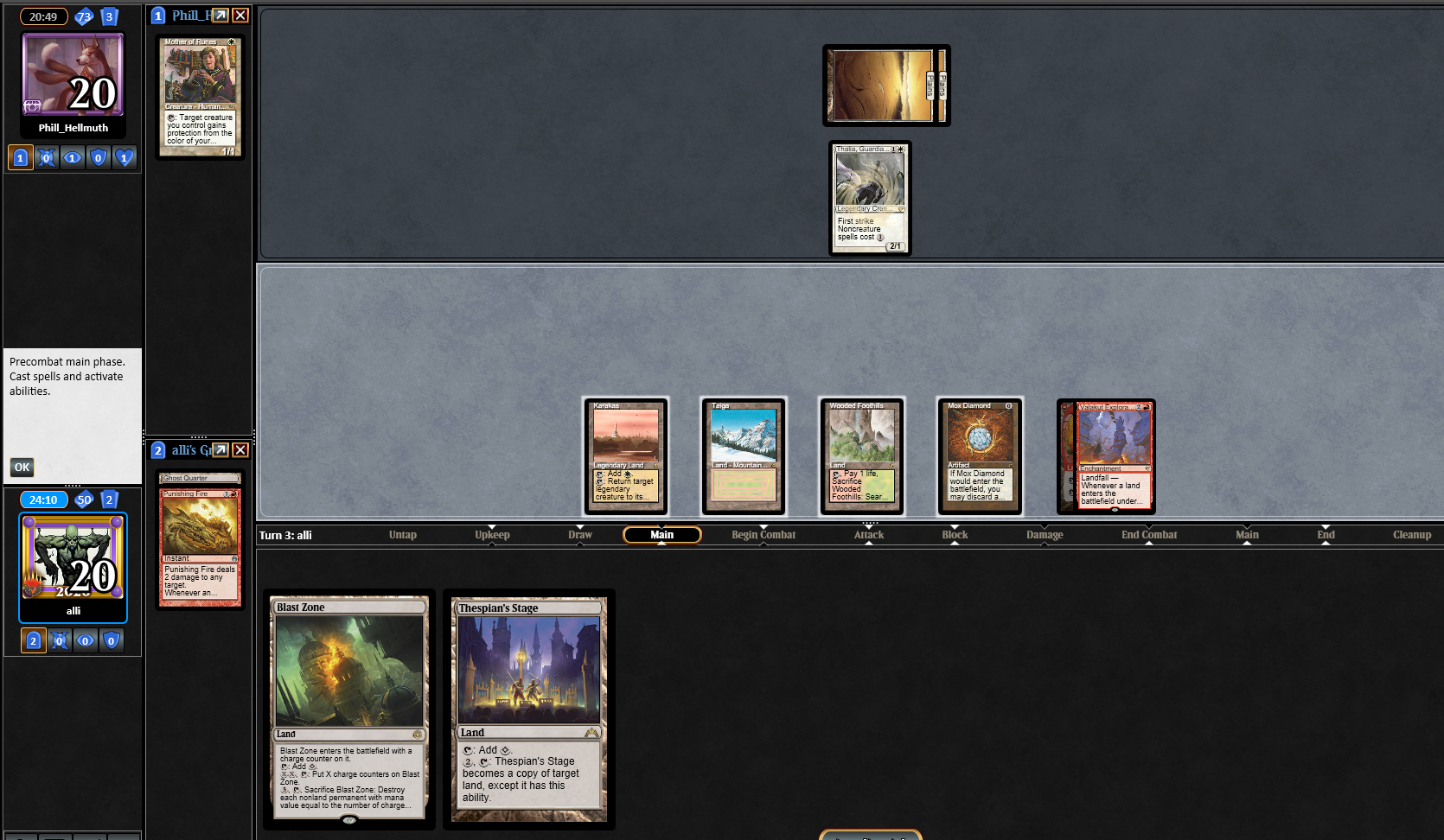
I expected Graveyard decks (Reanimate and Madness) to take up 13% of the winner’s meta and this was spot on as I ended up playing against these types of decks in 14% of my matches. Reanimate won the Showcase Qualifier Event in December last year and it was on everyone’s mind when I started this project. I think having access to white removal really helps against Reanimate as (even with 3 Endurance) it can sometimes be hard to stop them from reanimating a creature and Archon of Cruelty is non-legendary so it cannot be bounced with Karakas. Having Swords to Plowshares as a clean answer to Archon will win some otherwise unwinnable games against Reanimate. I think my Bant Saga Lands has a healthy mix of permanent and spell based hate and I feel comfortable playing against Reanimate with this configuration.

Madness is an interesting matchup that reminds me a lot about Hogaak. It is more explosive but it lacks the combo finish with Altar. Historically the Lands strategy has been good against these “go wide” types of Graveyard decks as Tabernacle, Bojuka Bog and Marit Lage are all great in the matchup. I also think Bant Lands is favored vs Madness and I went 2-1 in the matches that I played against them.

Elvish Reclaimer is an absolute all star against Graveyard decks and if we get to untap with him then it feels hard to lose. He dodges all the artifact and enchantment hate that Reanimate plays, and he puts them in a difficult spot because they won’t have many turns to find an answer before he finds Dark Depths and Thespian’s Stage. Reclaimer also acts as an extra Maze of Ith against Madness, and he will find anything that we need from Tabernacle to Bojuka Bog and Dark Depths. I absolutely love a proactive card that can play defense!

I played against Graveyard decks 3 times on camera and you can find them here.

Tribal Decks

I didn’t face a Tribal deck (Elves, Goblins or Death & Taxes) in any of the Prelims that I played. However, I did manage to get a testing session in with EronRelentless. We tested Bant Saga Lands vs Reclaimer Elves. My goal with the session was to figure out if Punishing Fire is needed to reliably beat Elves. 

My strategy in the pre board games was to keep a hand with light disruption (Swords or Tabernacle) plus a turn 3 Marit Lage. This went really well as I won both pre board games. Shadowspear was surprisingly good here as a way to Trample over Endurance. 

My strategy in the post board games was the same as in the pre board games but I also had the option of landing Spheres and Tabernacle to completely prison the Elves player out. I went 2-1 in the post sideboard games, and the only game that I lost was one where my hand was filled with interaction but no clear path to victory. 

I think this demonstrates that Punishing Fire is not needed to beat Tribal decks. What about the Death & Taxes matchup? I have tested this before and found that Urza’s Saga beats everything that they do outside a turn 2 Stoneforge into Kaldra. This means that maximizing Saga every turn and saving our removal for Stoneforge (or the Kaldra gem as our removal exiles) should be good enough. Post sideboard we can even destroy the Kaldra itself with Force of Vigor if we activate Shadowspear to make their permanents lose Indestructible. 

My testing session against Elves can be found here.

Dark Ritual Decks

I expected 6% of the winner’s meta to be on spell based combo (Storm or Doomsday) and this was pretty accurate as I ended up playing against these decks in 8% of my matches. Bant Lands is well suited to face these decks after sideboarding. We run a healthy mix of permanent based and spell based hate. For example against Doomsday we have the following relevant interaction:

  • Spell Based
    • 3 Endurance
    • 3 Flusterstorm
    • 4 Crop Rotation (for Ipnu).
  • Permanent Based
    • 1 Thran Foundry (+4 Saga to find it)
    • 1 Ipnu Rivulet (+7 ways to find it)
    • 4 Sphere effects + Wasteland

We also have a pretty decent clock with Constructs, Reclaimer and Marit Lage. It’s very hard for Doomsday players to build a pile that can beat Ipnu Rivulet and I therefore find that Lands have inevitability in the matchup. Unless we die on turn 1 or turn 2 then we will be able to find Ipnu and lock up the game. But if our opponent rushes then they play into our spell based interaction and can get destroyed by a timely Flusterstorm or Endurance.

I went 1-0 vs Doomsday and 1-0 vs Ruby Storm to a nice 100% winrate against this historical bad archetype. You can find my matches below: 

Other Decks

I played against “other decks” in 4 of my matches. I went 2-0 vs Cloudpost and 2-0 vs Lands. There is not much to say here really other than that Urza’s Saga has given us a new route to victory against these Crop Rotation decks. Saga is a safer kill than Marit Lage and I ended up going for that route in most games. I also think Prismatic Ending was excellent against Lands as a cheap way to remove a Mox Diamond or Exploration or Marit Lage.

You can find my matches here.

Conclusions

It is time to draw some conclusions from the experiment with Bant Lands. As I wrote in the introduction 24 matches is a very small sample size but when tuning magic decks we need to draw conclusions based on incomplete data as there is just not enough time to get large datasets. My conclusions here are therefore based on magic theory and backed up with the games that I have played these last few weeks. 

Hypothesis 1: I was worried about playing against the Blue-Zenit deck with RG Lands and my hope was that Swords to Plowshares would help in this matchup.

Conclusion: I don’t think that Swords to Plowshares is enough to swap the Blue-Zenit matchup. Sure, it helps but they are still favored against Bant Saga Lands. If we want to beat these decks then we need to play their game i.e. we cut Saga and play Reclaimer, Flagstones, Uro and Field of the Dead ourselves.

Hypothesis 2: I did not think that Planeswalkers would be popular and I was hoping that Constructs + Pithing Needle would be enough to combat walkers. Karn in particular felt horrible to play against but I was not predicting that card to be heavily played.

Conclusion: Planeswalkers were more popular than I had expected. Control decks started playing T3feri (that is amazing against Urza’s Saga) and Narset, and the Karn decks were more popular than I had anticipated. Constructs plus Needle do a decent job at combating walkers though. I love that Needle can shut off a walker before it hits play and this ensures for example that Karn won’t be able to tutor for Ensnaring Bridge before getting killed. I did play some Leagues with RG Lands (with Spellbomb instead of Needle) and I missed having access to Needle in these Leagues. It even turns out that I had a positive record vs Karn decks with Bant Lands. Punishing Fire would improve the situation vs walkers though and it seems good vs the deck with Narset, T3feri and Hullbreacher.

Hypothesis 3: I did not think that I would miss Punishing Fire against the Tribal decks but this remained to be seen.

Conclusion: We can beat Tribal decks with other strategies than recurring Punishing Fire. 

Hypothesis 4: Flusterstorm is the only card that I can think of that is good against TES, Show & Tell and Doomsday, and I expected Bant Lands to be better against spell based combo decks.

Conclusion: I felt favored vs spell based combo (including Doomsday) with Bant Saga Lands. Game 1 is awful but in the post sideboard games then we have a healthy mix of spell and permanent based hate, and we have plenty of tutors to find our hate. We also have a decent clock to back this up.

Hypothesis 5: Elvish Reclaimer felt great in the meta but I did not think that I would have room for Urza’s Saga and Reclaimer in the same deck. 

Conclusion: Elvish Reclaimer was the card that impressed me the most in Season 1 of Competitive Lands. He is great vs Daze decks and any deck that does not run removal (Elves, Madness, 8-Cast, etc). If we can protect him with Flusterstorm then he can also do major work against control decks ramping us towards Field of the Dead with Flagstones.

Next Season

I will be taking a break from the Competitive Lands Project while I plan Season 2. We just had a B&R announcement where Ragavan got the axe. I have posted my thoughts on what this menas for the Legacy meta, and I hope that you will come back and watch Season 2 when it starts in a few weeks time.
Thanks for reading!

Season 1 Recap

Here are all Episodes in Season 1 in case you missed something.

Competitive Legacy Lands Project Launch by alli
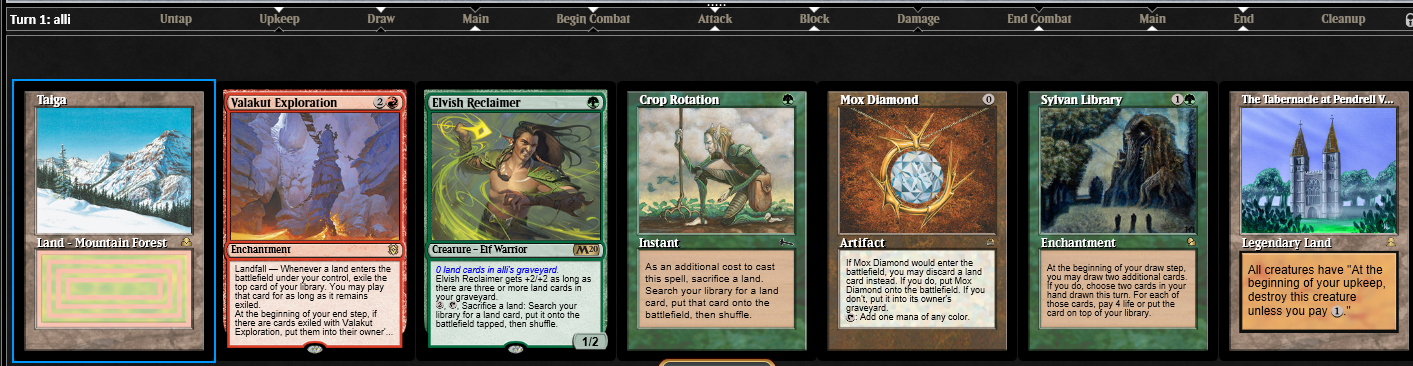
My name is Albert Lindblom, and I am an online grinder playing Legacy Lands under the MTGO alias alli. I have played Lands online for years and have multiple good finishes in premier events such as Showcase Challenges and the Eternal Weekend online. This year I am kicking off a new project with the aim of showcasing Legacy Lands from a competitive perspective. This will be done via a combination of (short) articles, videos, and live discussions in the Lands Discord. You can also find a video introduction to this project here.
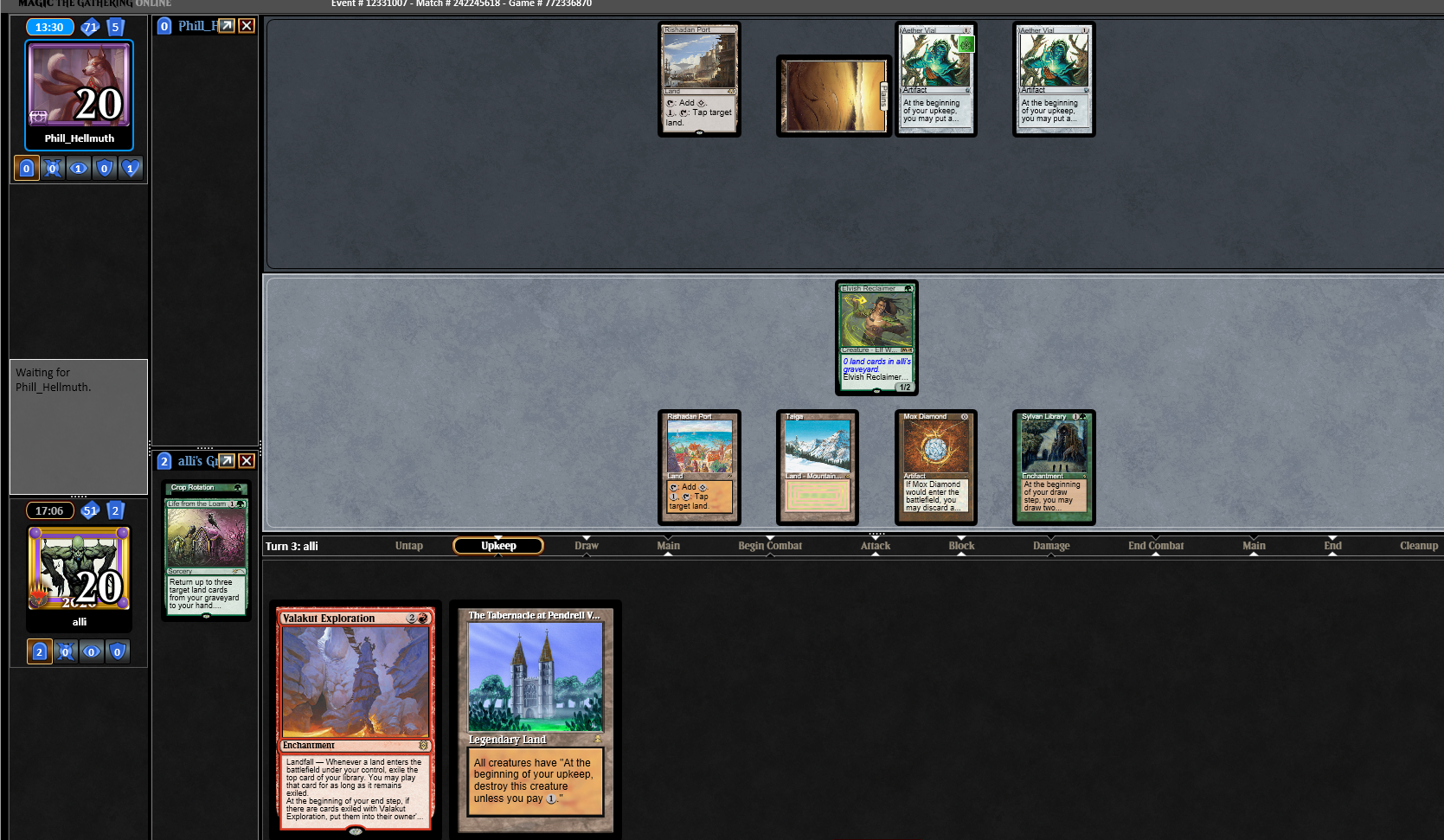
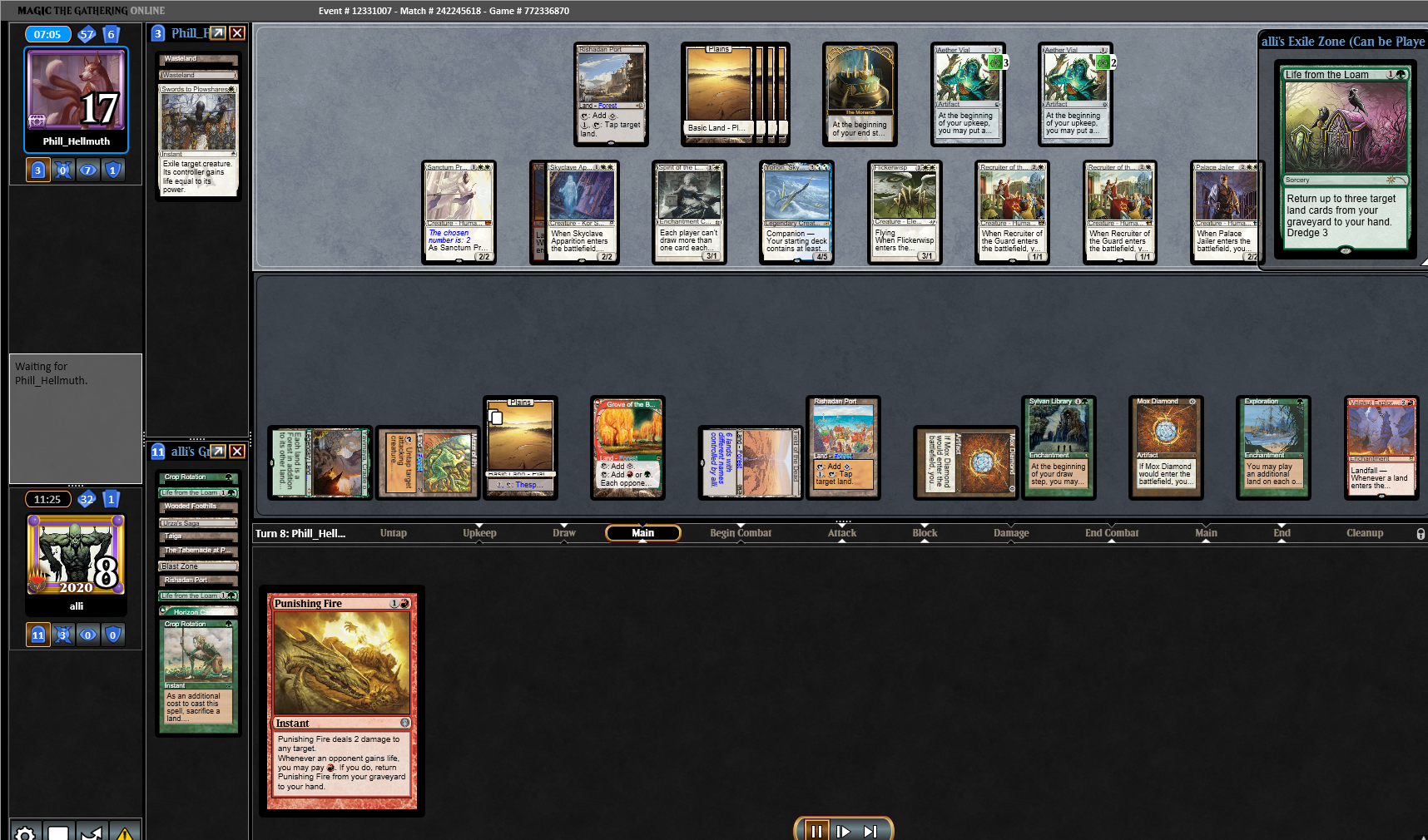
Decklists 

I will play different variations of Lands (RG, RGu, RGb, GW, GWu, GWr, BG and BGu), and I will try to stay with a variation for at least four weeks so that I can arrive at a list that is well tuned for the expected winners’ meta in online Challenges. I will kick off each variation with a short article that highlights why I chose to play a certain splash color, and I will also end with an article that explains my conclusions. To ensure that my list is well tuned, I will follow the principles that I describe in this article. If you join the Lands discord, you can even help me tune the list in the #decklists section.
Gameplay

I intend to play one competitive tournament every week. This will be one of the following:

  • Prelim
  • Challenge
  • Showcase Challenge
  • PTQ

If I want to test something specific, then I will also organise a dedicated testing session with another online grinder. All matches will be recorded and posted on my YouTube channel.

Conclusion

After four to eight weeks, I will try to post an article on PendrellVale.com with my conclusions about this specific Lands variation. In the article, I will address questions such as these:

  • How did the deck feel? What was my overall record?
  • How did my meta predictions line up with the decks I faced? Did I predict the meta correctly?
  • What did I win against?
  • What did I lose to? Can these matchups be improved without adding another color or giving up percentages in other matchups?

I hope you will enjoy this content! Let’s dive right into it and explore the first iteration of Lands that I want to play.

Expected Meta

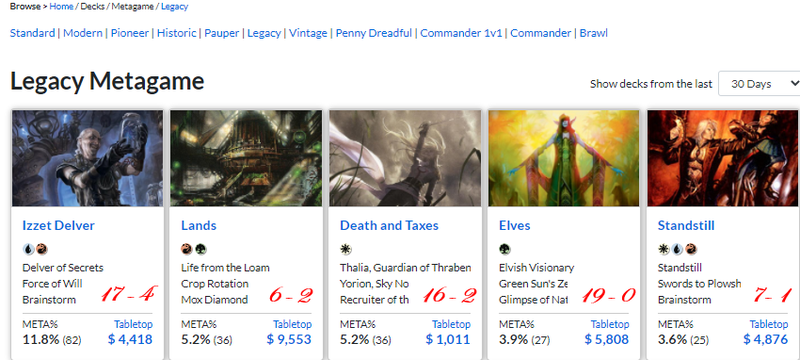
I had a look at the Top 32 from the last three challenges (Dec. 12 to Dec. 26). They show the following winners’ metagame.

If we consider matchups that have >5% meta share, then I think that the top decks are Delver, Blue Zenith, Reanimator, Elves, various Urza’s Saga decks (8-Cast, Painter, Lands), and Doomsday. 

Bant Lands

I am going to start by playing Bant Lands. Why do I want to abandon red and play white instead? The main reason is that white provides better removal and another broken land in Flagstones of Trokair.

Swords to Plowshares vs. Punishing Fire 

Let’s talk a bit about the difference between  white and red removal. Swords to Plowshares answers Murktide Regent, which means that we don’t need Pyroblast against Delver (and we can instead run up to 3 copies of Flusterstorm). Flusterstorm improves the Doomsday, Reanimator and Blue Zenith matchups. These decks make up more than 40% of the winners’ meta.

Punishing Fire is very good in the Tribal matchups and against planeswalkers. I expect that Tribal decks (primarily Elves and Death and Taxes) will be fine even without Punishing Fire (this will have to be confirmed in testing, of course). We win most games vs. Elves with early disruption and a semi-fast Marit Lage, and the most-difficult-to-deal-with card from Death and Taxes is Kaldra Compleat, and that card is not answered by Punishing Fire (but it is answered by the white removal). Most planeswalkers can be killed with constructs or stopped by a timely Pithing Needle (which can be found via Urza’s Saga’s third chapter). Karn, the Great Creator is the only planeswalker that I am truly scared of, but the Karn decks are not popular right now, and I hope to dodge them.

Elvish Reclaimer or Urza’s Saga

Adding white to our deck also allows us to play Flagstones of Trokair. This land is very interesting. First, it removes the drawback of Crop Rotation, transforming it from a semi-risky line vs. blue decks into a split card of Tinker and Hymn to Tourach (depending on whether the opponent decides to Force of Will it or not). Second, Flagstones of Trokair combined with Elvish Reclaimer ramps us by one land drop every turn that the cards are online. A hand of Forest, Flagstones of Trokair, Elvish Reclaimer, and Thespian’s Stage represents a turn three Marit Lage, and a hand of Forest, Flagstones of Trokair, Elvish Reclaimer and Life from the Loam allows us to have Field of the Dead online as early as turn four. 

However, Elvish Reclaimer and Urza’s Saga both require more than 8 slots (see the below table), and it can be difficult to fit both packages into the deck at the same time. I am leaning toward Urza’s Saga being better, as it’s a more powerful card and it kills quickly if the opponent stumbles, but Elvish Reclaimer is very strong against decks without removal, such as Elves, 8-Cast, Reanimator, and the Madness deck. I do want to test the Elvish Reclaimer package in the weeks to come.

Urza’s Saga PackageElvish Reclaimer Package
4 Urza’s Saga4 Elvish Reclaimer
3 Tutor targets2 Flagstones of Trokair
1 Crucible of Worlds2 Field of the Dead (or 1 FoTD and 1 Vesuva)
0-3 Sphere of Resistance0-3 Uro
Total: 8-11 cardsTotal: 8-11 cards

For reference, here are two sample decklists of Bant Saga Lands and Bant Reclaimer Lands. The first Prelim that I recorded with Bant Saga Lands can be found here.

Lands Round Table – 2021

May your new year be this full of growth

Inspired by the excellent Legacy Round Table articles by Joe Dyer, I thought it might be fun to do something similar for the Lands community to wrap up the year. So I pulled together a bunch of Lands players to get their opinions on how our favorite deck did this year. You may recognize some of these names as old masters of the archetype, others are legacy grinders, and yet others are just newer players sharing their perspectives. Here’s who we’ve got on the roster:

Dave Long (@DaveLongMTG)

ZoneEnder120 (Colby)

McBain from the Canadian Threshold Podcast

Matt Brown (@MattBrown_MTG)

urawik (@kiwaru2)

Squid (@SquidJPN)

Pearson Caldwell (@PearsMTG)

RavenousPanda21

NetherLands

Philip Neoshinji Tribbia

Adam Wasburn-Moses (@adamwasmo)

One thing I am particularly proud of is that we have contributors from all around the world, from experienced pros in the US & Canada to Japanese masters, European champions, and Australian experts. Note that for some of responses below, English may not be the author’s primary language.

How much Lands did you play this year? What drew you to the deck?

Dave Long: Due to the ongoing pandemic I played significantly less legacy than I have in past years. I’ve never really gotten into MTGO. I played lands at the Legacy Pit Open and some smaller local events. I’ve enjoyed the deck of late and think it is well positioned in the current meta. Before MH2 I had been playing a wide range of different Depths variants but at present only the GW build appears competitive (and that one doesn’t particularly suit my playstyle).

ZoneEnder120: I have only gotten to play intermittently as I’m primarily a paper player but I have got to play and win a few local events over the last year. What drew me to Lands was the ability to play on a completely different axis of magic then what everyone else was doing, the combination of uniqueness and inevitability felt really cool when I first saw it which was back around 2015 range or so. Also had a super cool name of Eternal Garden that some of the players around me still called it. But if I had to pick one thing it would have been that I have the opportunity to invalidate a lot of traditional plans and force them to play my game each round.

McBain: Lands was likely my second most played deck this year behind a new-found affection for DNT following the release of MH2. I was drawn to the deck years back after Painter fell out of favour. Being able to play multiple roles as well as have a combo is very appealing to me. Like Painter, Lands is a really interesting and unique deck. It is really a shame that Tabernacle is such a cost prohibitive card in paper and likely pushes people away from really learning the deck.

Matt Brown: I picked up Lands around March time this year for an online NRG event because my go to deck, Sneak and Show, wasn’t very well positioned. I wanted to play a deck that was good against Delver and I also enjoy playing decks that play on a different axis to the rest of the field so Lands felt like a perfect choice. I went 9-0 in the event and never looked back.

urawik: I played from January to September, but I played much less often than usual. I haven’t been able to play much since October. However, I enjoyed playing it very much. The disappearance of Gamble and the fixation of Valakut Exploration, and the appearance of Urza’s Saga are very exciting changes for people who have been playing Lands for a long time.

Squid: About 500 matches. I love sorcery-timing control of MTG. I tested several types of those decks, and Lands perfectly fits my style.

Pearson Caldwell: I am actually brand new to playing Legacy, but I’ve been a long time fan and observer of Lands.

I played Magic way back in elementary and middle school starting around Ice Age. I took a long break until a few years ago when I got really back into it, and it’s been consuming most of my free time ever since. I first saw Lands in the top 8 of an SCG tournament. I figured Legacy would be a wildly unfair format with most games ending on turn 1 or 2, so when I saw someone looping Wasteland and Punishing Fire for every little edge of value, I got really intrigued. 

I’ve been following the deck since then. I’ve finally been able to play with it thanks to the card rental services, and it’s been a blast to play. The deck has so many lines and really rewards optimal sequencing and planning multiple turns ahead. For the longest time, I thought of Lands as the platonic ideal of everything I wanted in a Magic deck, and so far it’s lived up to that measure.

RavenousPanda21: I’ve played a decent amount of lands this year as my primary ‘competitive’ deck although not as much as I would have liked. Majority of my play is spent in leagues or direct challenges with friends – being in Australia means that the competitive events are not at good times. The Saturday challenge (the only one I can play) is not firing anymore either.

In terms of what drew me to the deck, it’s mainly the resilience and toolbox nature of the deck. Crop Rotation provides a lot of lines and many different decision points in any given game but this is also what makes the deck challenging. Urza’s Saga has also really grown my appreciation for the deck and I really enjoy that playstyle combined with the traditional grindy elements.

NetherLands: A lot of games. Hundreds. My one and only deck.

Philip Neoshinji Tribbia: For the year of 2021 Lands was my Legacy deck of choice.  I did dabble with TES and Bant Control, however that was just to get a better idea how beat those decks. Legacy Lands since I started playing it in 2017 continues to be the most rewarding deck I have ever played. You can tune to beat any 2 out of 3 deck archetypes in the format. 

Adam Wasburn-Moses: I really only picked up the deck towards the end of the year when I knew I was going to have to pick up a deck for the NRGs because I had access to legacy cards.  Lands was a strategy I had enjoyed playing in the past and the build I started testing felt like it had a lot of promise as well as an actively good delver matchup.  I also knew almost all of the better players in the room would be on delver, so I locked it in.

What changes to the deck did you see this year?

Dave Long: The largest change to the deck (and all decks in legacy/modern) was the printing of MH2. This had a tremendous shift in the meta which made lands better positioned. In addition, lands was able to incorporate three key new cards in Urza’s Saga, Endurance, and Yavimaya, Cradle of Growth. Urza’s Saga in particular is a major upgrade to lands.

ZoneEnder120: This year we had a ton of changes including I think a few gameplay elements in our ability to actually close matches, as prior we had the option of either being the combo or the prison but thanks to Urza’s Saga we now have the option of being the beatdown. We also due to several factors, including Force of Negation have added more engines or ways of keeping our velocity moving while relying a little bit less on Loam than before but it still being a mainstay for the strategy. So beyond the nitpicky on card choices, since there has been so many, I think the main thing is that we have had a fundamental shift from being a 2D deck in terms of how we approach a match up to closer to having 4D options between Saga, combo, Loam Lock, and Valakut. We just have so many more options than before and are less limited in game plans.

McBain: While I have bent the knee to our MH2 overlords and adopted Sagas and Endurance I don’t really like the Saga version, or how it forces you to play – or how it plays in general. Making a bunch of robots often feels boring and unnecessary to me.

Matt Brown: There were a lot of changes in the deck this year from when I picked it up mostly from the release of Modern Horizons 2 and the emergence of Urza’s Saga. This meant that a lot of people were fundamentally changing how the deck was built to try and abuse the power of Urza’s Saga by cutting other early uses of mana such as Rishadan Port and cutting some of the main deck spell slots for tutorable artifacts.

Shortly after the release of MH2 I took a break from grinding mtgo so never really got to test out different configurations but I am still not sure how many copies of Urza’s Saga Lands lists should be playing, I could see any number being correct.

urawik: I only have Lands in MO, so I haven’t played any other decks. I didn’t play Lands on paper, but played various decks such as Depths, Maverick, Jund and Mono Green Post. I often thinking about Lands, and it was very fulfilling. In the process of playing them, there were many things that were useful in considering Lands, and I think it was very fulfilling.

Squid: Valakut Exploration. It was like training wheels when I started playing it, but VE forms the basis of my deck nowadays.

Pearson Caldwell: The biggest change has to be the addition of Urza’s Saga. Saga has totally warped Lands’ strategy (and the Legacy format) around itself, filling so many gaps the deck used to have. It gives you a great mana sink, an interesting tutor suite of artifacts, and an incredible endgame looping Saga with Loam. 

Saga feels like potentially the strongest card in Legacy at the moment, and there’s a question of what deck makes the best use of it. I think Lands has a good chance to be that deck as the metagame continues to shift and we continue to refine decklists.

RavenousPanda21: The big changes in Lands this year have all been driven by the printing of MH2 – both in terms of cards we can play and cards we have to beat. With the addition of cards like Prismatic Ending and powerful threats like Ragavan, Nimble Pilferer and Murktide Regent, the format is under more pressure than ever before. It is absolutely critical that you play hard-hitting cards that generate a lot of value/utility.

This is where Urza’s Saga and Endurance have really changed the game for Lands. I think I was one of the earlier adopters in terms of praising the power of Saga, and while the lists have changed a decent amount since then, the fact that Urza’s Saga is insanely strong remains. This card has really taken the deck to the next level and allowed lands to have a linear game plan other than dark depths. Due to an over-abundance of white in the format (thanks Prismatic Ending), answers to Marit Lage are plentiful right now; that’s not to say Dark Depths isn’t still extremely good to have in the deck.

Personally, the thing I enjoy the most about Saga (other than crushing skulls with chonky robots) is that we get to play more toolbox elements in the form of 1-mana artifacts. The ability to play cards like Pithing Needle, Expedition Map, Shadowspear, Pyrite Spellbomb, Retrofitter Foundry, Thran Foundry, Grafdigger’s Cage, Soul-Guide Lantern… the list goes on. This provides the deck with another angle and allows us to answer things we haven’t been able to answer before. You don’t realise how good maindeck Pithing Needle is until you try it out.

Endurance is the other big addition to the deck (whether in the sideboard or main) and has given lands a big leg up in certain matchups. Endurance pairs up excellently against a meta with cards like Dragon’s Rage Channeler, Murktide Regent (if you preemptively play it), Thassa’s Oracle, Uro, Titan of Nature’s Wrath, Reanimate etc. Not to mention a 3/4 flash reach blocker is just generically good and isn’t that difficult to hard-cast especially with honorable mention Yavimaya, Cradle of Growth. The shift to playing Endurance in the main with Shadowspear has been quite interesting and something that I have really come to enjoy.

NetherLands: A lot. Biggest is Urza’s Saga and the artifact packages. 

Was a slow starter at first. Didn’t see. Then started with 1, tried 3,went back to one. 

Now playing a full four for a while which is correct. Such a powerful land.

Another interesting change was putting Valakut Exploration to the side and main the Endurances. But this is more an (online) meta call.

Philip Neoshinji Tribbia: The printing of Urza’s Saga, Endurance, Yavimaya, Cradle of Growth, and Shadowspear 2021 was a great time for Lands if you were a brewer.  The card that pushed Lands over the top was Urza’s Saga which gave us the ability to have mana source, toolbox, and clock in one card.  I decided to revisit my approach to have my main deck configuration of Legacy Lands be as preboarded as possible vs the 2 archetypes I was wanted to beat (URx Tempo decks and Combo Decks).  This meant putting cards like Valakut Exploration would be kicked to the sideboard and putting Endurance in the main deck.  For 3+ Months (paper and MTGO) my win percentage I went 13-1-1 vs URx Tempo and 14-3 vs Combo.  Worth mentioning that my configuration came at a cost of having a bad record vs any UWx Control Deck going 1-4-2.

Adam Wasburn-Moses: The introduction of Urza’s Saga was a MASSIVE boon for the deck, but also completely changed the way many matchups are played.  Getting a win condition that is not built solely around Dark Depths can be huge in a bevy of matchups, especially the more controlling ones.  The introductions of MH2 threats in Delver made Punishing Fires significantly worse than it has been in the past, and is not a card I’m interested in registering at the moment.  Endurance is a pretty big upgrade for the deck as a generally useful card that can win the game by itself versus Doomsday (previously unwinnable) or even Storm or Reanimator.

If you were to play a competitive event tomorrow, what build of Lands would you bring?

Dave Long: I would bring a RG build containing four Urza’s Sagas with a smaller Saga package (i.e., no maindeck Pithing Needle or Retrofitter Foundry).

ZoneEnder120: I would be bringing a base red and green list focusing with Saga. The bigger questions become 2nd Ghost Quarter, first Field, Sphere or no Sphere which has been a new debate. Potentially Chalice in the board in those slots might be interesting. But in an open meta I think the value of our traditional proactive builds combined with the versatility we would be very well positioned. As far as splashes the blue splash for Dack Fayden and Fluster seems like it could be very powerful, or black going into Plague Engineer and Thoughtseize actually could be quite good also, again just depends on if the meta has changes or not what ends up being the top.

McBain: I’ve (always) been drawn to how lands grand master Hori Masataka builds and plays the deck, so I would likely be looking there first, then making some adjustments for what I expected to see regarding combo and control.

Matt Brown: I would likely bring a close to stock list with 3 Saga, Pithing Needle, Expedition Map and either Pyrite Spellbomb or Retrofitter Foundry as tutor targets. 4 Depth, 4 Stage, 3 Maze of Ith and 0 creatures in the main deck.

urawik: RG Lands. (0Saga/MD 3Endurance) I chose not to play Saga. It may be a little classic list, but I think it is well differentiated from Saga Lands. Reclaimer isn’t as great as it used to be. The main reason is the introduction of Unholy Heat. I’m currently working instantly and playing Endurance, which can also be a main Reanimator measure.

https://mtggoldfish.com/deck/4516181#paper…

Squid: No Removal Saga Lands. https://www.mtggoldfish.com/deck/4428444

Pearson Caldwell: This is my current decklist. As I’m relatively new to the format, I haven’t strayed too far from the classic RG build of Lands, with the full playset of Sagas. I’m not a fan of cheating sideboard cards into maindecks, so I’ve left Endurance in the board. 

I play Kaheera as my companion, which means no Elvish Reclaimers. Having Kaheera to pitch to Force of Vigor or Endurance can be really relevant, and Reclaimers often end up eating opponents’ otherwise dead removal.

For my Saga targets, I’ve been running Expedition Map, Pyrite Spellbomb, and Soul-Guide Lantern in the main, with Grafdigger’s Cage and Pithing Needle in the board. Reanimator is really popular right now thanks to Kanister’s Legacy Showcase Challenge win with it, so the extra graveyard hate has been nice to have. Cage also turns off Green Sun’s Zenith, which is seeing a lot of play recently in the four-color Yorion pile.

I go back and forth on the Dark Depths combo. It’s nice to have that “I win” button, but it does lead to a lot of blowouts. If the combo doesn’t win you the game on the spot, you’ll often end up losing. While you can sometimes play around these spots to avoid the blowouts, other times you draw your combo with nothing else going on, and you’re left with no choice but to go for it and hope it works. I frequently board down to one copy of Dark Depths so I can Crop Rotation into the combo when it’s good. I’m currently on three Depths, but I’m considering going down to one copy and building more around Urza’s Saga.

I recently cut Sphere of Resistance from the board. I like Sphere as a catch all for a lot of problem matchups, but it’s a flawed card that sometimes doesn’t do enough. I think filling in those slots with more copies of the good cards you’re already playing, along with some Saga targets, is a good starting point for a post-Sphere sideboard.

I also have one major change I’ve made to my list, which I’ve outlined in my response to the next question.

RavenousPanda21: If I were going to a serious competitive tournament, the below is what I would bring. I’m still a believer in solid RG and think Punishing Fire and Red Elemental Blast/Pyroblast have a lot of value in the meta. I am also 100% a believer in mainboard Endurance with Shadowspear and have been enjoying this configuration a lot. I have been off Valakut Exploration for a while and my hot take is that it is often a win-more card that creates awkward sequencing, especially in a saga-focussed build.

I solidly enjoy having 4 saga targets and prefer Retrofitter Foundry over Pyrite Spellbomb that is often in stock lists. I think Retrofitter is insanely good at what it does and I have won many games where it just takes over by itself. Another notable inclusion in the mainboard is Crucible of Worlds which I have been enjoying a lot. I think there are a lot of green piles in current legacy and Wasteland/Ghost Quarter recursion is very powerful at the moment; not to mention the card is very, very strong with Urza’s Saga and recurring them turn after turn can be very disgusting.

I am pretty firm on my current sideboard options. I really like Alpine Moon and think people across legacy are sleeping on this card. It is great in the mirror, against other Wasteland decks, anything with Saga, Elves with Gaea’s Cradle (the deck looks pretty bad without Cradle), anything with Field of the Dead or Dark Depths etc etc. Thran Foundry is a pseudo gy hate option that is also interaction for Doomsday. I have recently started playing it over the Soul-Guide Lantern that I had previously. Grafdigger’s Cage is very strong at the moment with the increase in Blue Zenith strategies (as well as mainstay GW Depths) and is also hate against decks like Reanimator.

I have been in love with 4 copies of Blasts for a while and the rest of the sideboard is pretty stock other than my Endurances being in the main. List below.

NetherLands: RG. I like the conventional traditional builds.

But I would main the Valakuts. And 4 saga’s and 3 tutors. And probably Crucible main. No Ports.

Philip Neoshinji Tribbia: I feel like URx Tempo is still the top deck to beat so I would play the exact same list I have been playing for the past couple of months.  While my list is bad vs Control decks in general, I feel like I can just tough it out and hope that I have more experience than my opponent in the match up.

Adam Wasburn-Moses: https://www.mtggoldfish.com/deck/4498263#paper

Something close to this list.  Kozilek’s Return is more an admission to the paper metagame where more people play Death and Taxes, and could easily be changed for an online event for something like a Grafdigger’s Cage.

Are there any cards or strategies that you think are under-explored or under-utilized in Lands at the moment?

Dave Long: I’ve wondered about a build which more heavily leverages Yavimaya, Cradle of Growth. Perhaps cutting the red cards from the list.

ZoneEnder120: Out of pure nostalgia I am going to say Mishra’s factory still as it can still block and kill a Ragavan. But also has fun tricks with Urza’s Saga since if your opponent has tight combat math in a situation you have the ability to potentially Crop Rotate and animate to change numbers that previously weren’t there, more impactful on defense since you’re adding the 2/2 body on first turn since it can’t pump itself the first turn it’s in play due to summoning sickness but it bumps up every construct by 1. A more serious thing I think might be under utilized is Chalice if we are thinking of trying no Spheres since Chalice on zero in the current meta hits a lot of the problems and Chalice on 1 blanks all the threats out of blue-red except Murktide until they find Meltdown as a point of contention but can definitely hold them in check if dropped down early.

McBain: Somewhat evident in my prior responses, but continuing to explore lists with just 1 Saga as utility like Hori would be a good step. Additionally, I’ve traditionally been a big fan of Chandra the Awaken Inferno so seeing that pick up a bit recently is nice. It provides the powerful end game you’re looking for against control but also wrecks random fair stuff. I really miss the gamble style of old Lands deck where you could run a dozen one of’s and reliably tutor for them.

Matt Brown: Honestly I think that the old versions without Urza’s Saga are under-explored at the moment. You would likely lose some equity in the mirror so you could maybe play 1 Saga with no additional tutor targets outside of Mox Diamond but it feels like people aren’t paying any respect to Rishadan Port anymore which could make it a good strategy to be in.

urawik: Daretti, Ingenious Iconoclast. It’s a card that impressed me with Alli, but I think it’s a great card for RGb build. + Ability works well with Saga, – Ability can Destroy Murktide twice. Also, by adopting Crop, Saga and -Ability exerts a synergistic effect. I don’t like Sheltered Thicket very much because it’s a color land that doesn’t serve as a keep criteria. However, Slagwoods Bridge and Darkmoss Bridge are keep criteria. I am very much looking forward to building RGb Lands now.

Squid: Song of the Dryad + Thespian’s Stage/Vesuva. Copy Opponent‘s Uro!

Pearson Caldwell: I’ll answer this question in two parts: the first about a particular card for traditional RG Lands; the second about a potential different build of Lands.

The card I have in mind is Faithless Looting. I started playing with lists from top tournament finishes that included Valakut Exploration and/or Sylvan Library. These cards have a high ceiling, but also an extremely low floor.

Valakut Exploration is expensive, slow, and only really goes off when you’ve got regular Exploration in play. Put another way, it asks for a lot to go right, and doesn’t help you when things are going wrong. It looks really impressive when it does its thing, but there are too many games where it does nothing, gets countered, or you have to side it out.

Sylvan Library is at least cheaper, but it similarly asks a lot from the board state and from your opponent. If your life total is under pressure, you can’t draw many cards off it, and if you don’t have a fetchland or Loam to dredge, it’s easy to get Library locked for a few turns, which can be game losing. It’s similarly bad against opposing counterspells, which really hurts because the rest of the deck is so good against them.

With Urza’s Saga and Loam giving Lands all the late game inevitably we need, I’m more interested in high floor plays versus high ceilings. We don’t need to work as hard for card advantage with cards like Valakut Exploration and Sylvan Library in an Urza’s Saga world.

Faithless Looting feels like the perfect card for this slot. It’s cheap, efficient at what it does, great against counterspells, and is a nice hit off of a Loam dredge. We also have great tools to turn Looting into card advantage by discarding lands and getting them back with Loam or discarding Punishing Fire and getting it back with Grove of the Burnwillows. 

I know Looting has seen some play in Lands in the past. I’m wondering if it got put aside because the deck needed a more consistent late game engine. Urza’s Saga with Loam checks all of the late game boxes, so Looting seems well positioned to round out that slot. It’s possible four copies is too many, but I really wanted to stress test the concept, and I haven’t felt like I’ve drawn too many Lootings yet.

Second, there is a potential different build of Lands I’ve had in mind. I don’t have a finished decklist, but basically, something like a Bant control list that leans more deeply into the Lands package, with a playset of Mox Diamonds, Urza’s Sagas, Loams, some number of Crop Rotation, and maybe Exploration. I like the idea of combining the inevitability of Lands and Urza’s Saga with Uro, counterspells, and the removal you get from blue and white cards.

I’ve seen a few decks move in this direction. Kyle Vjorn’s 4c Loam deck from the Nerd Rage Gaming Legacy event hits on a lot of these concepts. There’s also the 4c Green Sun’s Zenith deck that has been popping up everywhere, which is basically playing Zenith and a suite of creatures to tutor instead of the Lands and Urza’s Saga package. 

I’m not sure what the threshold is for a deck to be considered “Lands,” but I think this idea has a lot of promise and I’d love to explore it more. Putting Urza’s Saga together with the best interaction in the format seems like a good place to be.

RavenousPanda21: Other than Alpine Moon as sideboard tech, nothing really stands out to me too much at the moment other than exploring other colours.

Alli has been doing some good work exploring Bant lists and I’ve tried a few different colours as well (mostly mediocre). I think I am mainly waiting to see if anything changes with the Legacy ban list and if there are any new interesting cards in the new Kamigawa set.

NetherLands: I still think that Uro + Exploration is very strong. 

And blue has some other merits. 

But I think that Lands should not play blue.

Philip Neoshinji Tribbia: I tested it out earlier as a joke, but ended up getting positive results with Ragavan, Nimble Pilferer.  Land into Mox Diamond into Dash Ragavan felt strong.  It enabled some turn 2 Lages as well as just give me information to what I was facing.  I feel like the correct number is 2x Ragavan but decided to not invest any more time/money into a card that was a good candidate to get banned in the future.  Depending on when or if a ban happens, I will revisit Ragavan, Nimble Pilferer and possibly adding a Stomping Ground to help smooth out the mana base.

Adam Wasburn-Moses: I haven’t seen many people playing Kaheera lately, which is mostly a free pitch card for Force of Vigor and Endurance.  The information gained by your opponent game 1 isn’t as relevant as many people make it out to be.  Endurance maindeck has been extremely good for me as well, and I’m surprised it isn’t catching on right now.

Going into 2022, how do you think Lands is positioned in the Legacy metagame?

Dave Long: I think Lands is very well positioned at the moment and would be an excellent choice for any legacy event. We will have to wait and see if any upcoming bans shakeup the meta at all but at present the deck is very strong.

ZoneEnder120: I think Lands continues to be a strong choice. I think the biggest weakness is Doomsday followed by sometimes cards don’t line up well or the plan we have isn’t as effective. But if the metagame is heavily fair I would say we are our own worst enemy and might have to even consider our mirror match going forward.

McBain: If Ragavan is banned, as I would argue for multiple reasons the least of which being power, then we could see a resurgence of decks that play Lotus Petal (Doomsday, Sneak, Omni, etc.) all of which are generally rather bad for Lands. If we continue on business as usual I think things could look pretty interesting.  

Matt Brown: I think that Lands will always continue to be reasonably well positioned and given the current metagame and the apparent reluctance to change the Daze/Brainstorm/Force of Will dominance, it means that Lands should be pretty well positioned going forwards since there is little combo around at the moment.

urawik: Depending on the ban revision, if nothing changes, I think you are in a good position.

However, if Ragavan becomes a ban, there will be concerns about an increase in combo decks. But with more combos, Yorion Piles like Blue Zenith are expected to go down. This is good for Lands (because it’s a bit of a disadvantage).

Overall, I don’t expect the position to change significantly in either case

Squid: In my opinion, creature-based Meta continues. If so, Lands keeps good position.

Pearson Caldwell: A lot of my answer to this question depends on bans. There’s a lot of talk about Ragavan getting banned, and Urza’s Saga could certainly see a ban as well. 

As long as Ragavan stays in the format, I think Lands can adapt to stay well positioned against the Ragavan decks. It’s possible people respond to Ragavan decks by moving into more combo decks that ignore mostly Ragavan like we’ve seen happen with Reanimator, at which point Lands could be in a tough spot. 

If Urza’s Saga were to get banned, that would really change the equation for Lands. If nothing changes, I think Lands is in a great position in the metagame. It’s putting up decent results as is, and it feels like decklists are still getting refined daily. There’s also still a ton of room to innovate in Lands deckbuilding, which will hopefully keep the gameplay fresh. 

RavenousPanda21: I think Lands is in a pretty good place overall outside of combo decks being a challenge (but they always have been).

Most of the top decks I’m not super scared of: UR Delver, Control, Elves, Death & Taxes

Reanimator has been growing in popularity and can be hard if you get t1’d, however we have more interaction than ever, especially if playing mainboard Endurance.

The one deck I am a bit scared of is Blue Zenith. While I have only played against it a few times, the matchup feels quite tough and the general consensus is that it is a very difficult one for RG builds. This is one of the decks that could result in me changing things up if it continues to get more popular.

Only time will tell with regards to the overall meta and I am interested to see how things shape up over the next year. All in all it’s a good time to be a fan of playing too many lands in your deck and still not finding enough of them. As we all know, Urza’s Saga is the story of a man who could not find his glasses, so he built some robots to help find them. Similarly, I’m going to need some glasses after typing all of this out!

NetherLands: I think it’s always tier 2, something like that. Not tier 1 or 0.

But it’s always hard to play against when you are a good pilot and I think you can still do well in big tournaments. It can adjust to the meta. Especially online. 

But it will be always hard(er) to win big tournaments with it.

Philip Neoshinji Tribbia: For 2022, I see nothing but good things for Legacy Lands per usual.  This is large part to how helpful everyone is in the Lands Discord Channel.  If decks like DNT, Bant Control, and 4C Zenith continue to be more popular Legacy Lands might be stuck in the uncomfortable position of having to chose between metagaming vs UWx Control/Combo or URx Tempo/Combo.  In my opinion, it is very difficult to have a configuring that is both good vs Tempo and Control at the same time.  I already have some ideas of how to pivot if such a metagame comes to fruition, but not worried.

Adam Wasburn-Moses: As long as people keep playing Delver and beating the combo decks, the deck will continue to be well positioned.

And there you have it! A big thank you to all our contributors and to the wonderful Lands community all around the world. Much love and Happy New Year!

Thanks to Sophia, the Vampire Queen’s amazing and wonderful partner for this excellent image

4th at the Legacy Pit Open with RG Saga Lands by Jake Romanski

Introduction

My name is Jacob Romanski (Jake) and I just finished top 4 at The Legacy Pit 20k Legacy Open on 18 September 2021. I’m from Allentown, PA and I started playing Magic around 2007 during my university days after having played Pokemon and Yugioh for quite a few years. I played Magic very casually for a few years before even coming close to the competitive scene. The days of needing to get my hands on every powerful, legendary creature to revolve my decks around still feel very recent, and I find this a bit nutty now since I’m writing an article focusing on a deck with zero creatures in the main list. I have a passion for strategy and card games with Magic settled nearest to my heart.

Lessons Learned

A few months ago a local game shop posted their first paper Legacy event since the start of the COVID lockdowns. I took this as an opportunity to play Lands in my first competitive arena, rather than just a bunch of game 1’s with my friends down the street (thanks for the practice Pat and Ryan). I felt in decent shape for the tournament after watching a few videos from players recently running the deck since the printing of Urza’s Saga and Endurance, both of which had some massive impacts on the new iterations of the deck. I was ready…and I ended 2-4 for the day which felt miserable, however I learned two very valuable lessons: I was not ready, and I needed to do something about all of my dead draws during game play (more on this later). After having played Legacy every week at my LGS pre-COVID I had learned that I was not that familiar with how the meta had shifted. So many powerful, legacy-impacting cards had arrived to the game since the pandemic began. At the end of the tournament The Legacy Pit crew reminded the players about their upcoming Legacy 20k which was to be held about six weeks later. It was settled, I decided there was no room for excuses. I would be ready.

I think the single most important thing I did was create a Magic Online account and jam as many leagues as I could while still maintaining a work and social life. In addition to this I watched about 200 YouTube videos spanning the last 5 years. I read as many articles as I could dig up. I also kept an eye on key websites that would post deck lists every few days for both online and paper in order to see what lists were performing well. About thirty MTGO leagues later I finally locked in a list I was about 95% happy with. Before I go into the list however, I want to quickly discuss the breakdown of this deck for any newer players and what I had learned from my time playing leagues. This type of guide would have been very helpful had there been one when I was learning the deck so I’ll share my thoughts on the matter here.

The Data

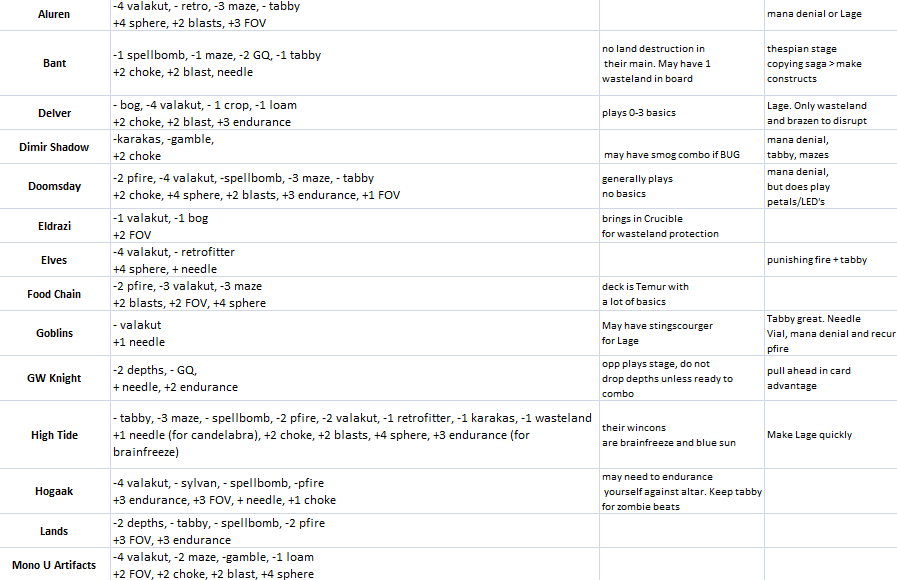
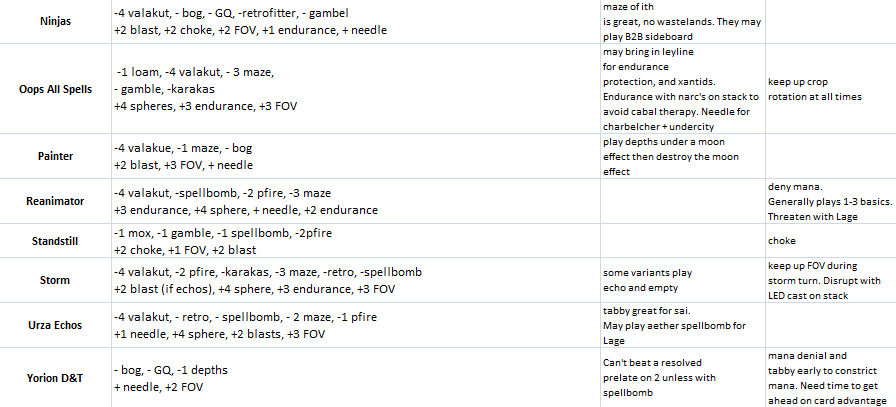
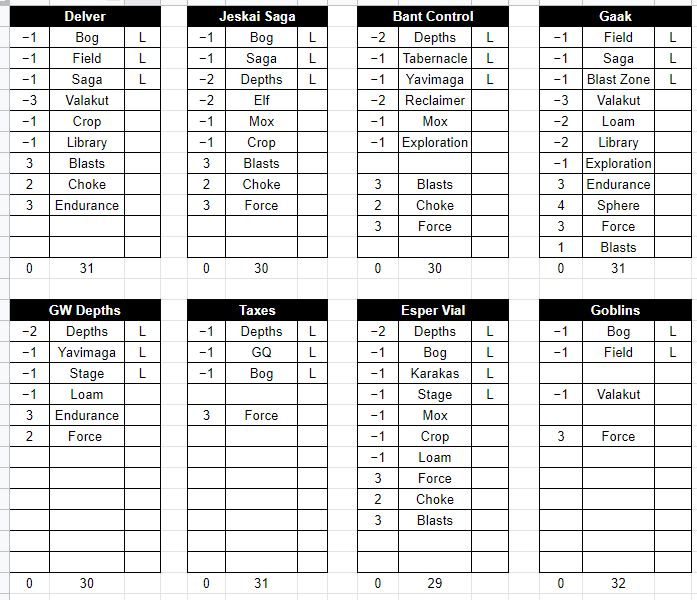
It took just a few leagues, and one rather heated Magic-related argument, before I decided that I should start planning a sideboard guide and taking notes if something caught me off guard from an opposing deck. It is these exact sorts of surprises that could spell defeat in a tournament, and this is exactly what happened to me at the local tournament a few weeks prior. My BUG Shadow opponent sideboarded into Smog combo and I had no answers, and it wasn’t even on my radar. The same thing happened again when my Oops All Spells opponent sideboarded into Goblin Charbelcher during a MTGO league. My inexperience with the current meta was what spelled disaster for me early on and I needed to begin to build my defenses against threats my deck couldn’t answer. The following data was more or less what I had gathered complete with some match-up notes to eliminate surprises main or post board and ‘Best WinCons’ in the last column as a way to streamline which method I should focus on in specific matches.

I like sideboard guides to a certain degree but it’s crucial to know what the main deck looks like in order to know how to sideboard based on that criteria. In addition, there are some matchups in which I’ll sideboard differently depending on whether or not I’m on the draw or the play, so the above guide is just that, and should not be taken indefinitely. This sideboard guide however was for me about 5 different iterations of playing Lands online (for example one iteration had 4 Ghost Quarters in the main, so if I sideboarded out all 4 of them with that list against a certain opponent I would have to find 3 different cards to sideboard out if a different list I was using contained a different number of them). I also tried different Urza’s Saga packages with these different iterations so those changed from league-to-league as well. I’ve also learned a lot since then, even though it hasn’t been very long, and may change depending on how lists evolve in the future.

One of the things I focused on was how I was winning games. The deck has the following primary winning strategies:

  1. Create a Marit Lage
  2. Mana denial until the opponent concedes (prison strategy)
  3. Beat down with constructs generated by Urza’s Saga
  4. Punishing Fire or Valakut burn

One of the things that I learned while practicing was I was too mana-hungry. I would try and tap out each and every turn for mana efficiency purposes. I realized very quickly that that isn’t such the case with this deck and that I should learn to keep up Crop Rotation at all times in case I need to grab a critical utility land. More often than not I would start my turn with Mox + land > Loam to get that engine online but then wish that I had kept up Crop, repeatedly getting punished for my mana efficiency addiction. In addition, there was a decent concentration of white decks floating around with the recent printing of Prismatic Ending. Almost every white deck carries a near full playset of Swords to Plowshares, Karakas and possibly some number of Solitude. The Lage line wasn’t winning as many games as I had first expected. The second thing that I noticed was that against another Saga matchup their constructs were generally larger than mine. One of the ways to combat this was the inclusion of Retrofitter Foundry (credit here given to Will Pulliam as he basically solidified my choice with a Tweet stating the card was great for him all day). Not only was the addition of RFF something that quite nicely buffed my constructs but this gave me now a 5th (and arguably better than the Punishing Fire) avenue to win the game, enabling me to generate enough servos to buy time until another engine won me the game or win by creature production. In addition, grabbing a Spellbomb or Map meant that the artifact that I tutored up would almost immediately leave the battlefield, reducing my Saga construct’s power and toughness. Grabbing RFF and having it pump out more permanent artifacts was something that really seemed worth it if I were trying to win with that route. Almost all other games were won using the mana denial strategy; i.e. recurring Wastelands and Ghost Quarters with Life from the Loam. With all of these data, I put together my list for the event.

The List

https://mtgmelee.com/Decklist/View/167009

I’m sure most Lands players would agree that the following cards are locked in in the current meta and for me these cards were solidified at their respective number.

  • 1x Blast Zone
  • 1x Bojuka Bog
  • 1x Ghost Quarter
  • 4x Grove of the Burnwillows
  • 1x Karakas
  • 2x Taiga
  • 4x Wasteland
  • 1x The Tabernacle at Pendrell Vale
  • 4x Thespian’s Stage
  • 4x Crop Rotation
  • 4x Life From the Loam
  • 4x Mox Diamond
  • 4x Exploration

After having gone 2-4 at the local tournament I realized that I was losing a lot of games by drawing dead cards, specifically Mox Diamonds, Explorations and land when I didn’t have a board state I could sink my mana into. My list for that event ran 2x Elvish Reclaimer, 2 Sylvan Library, 2 Valakut Exploration and I ran out of gas in almost every matchup. I wanted to make sure that my deck had something to do every single turn or that I had mana to sink into something every single turn in an attempt to always be progressing my board state. Here are my thoughts on the rest of deck options and the decisions that I wrestled with up to the day of the event.

Ancient Tomb / Yavimaya, Cradle of Growth: I almost considered running Ancient Tomb since I was running 4 Valakut Explorations and 3 Depths but I ultimately decided that there was no room for it. Yavimaya acts as a way to gain mana advantage by turning all of the non-mana producing lands into forests so I felt it a little redundant to run both, but I don’t necessarily disagree with both.

Field of the Dead: I tried this card for many leagues and many practice games in paper and I just never really liked it. The fact that it comes into play tapped and produces colorless mana ended up hurting me way more times than it ended up winning the game for me. I’m pretty anti-field when it comes to Lands but I could see an argument for running 1 copy in the sideboard against control matchups. If the meta ever ends up shifting this way it may make my 75.

Pithing Needle: I found that I was sideboarding this card out in more than 60% of the matches in which I tried running it in the main deck. I understand that Lands is a prison deck with a combo finish and Needle is an excellent prison card but going off of my strategy of eliminating dead draws meant moving this to the sideboard. If the argument is between having a card that’s good in some matchups but dead in most, then to me that’s almost the literal definition of a sideboard card.

2, 3, or 4 Valakut Explorations: As I’ve stated before, I tried 2 copies of this card at the local tournament and found that I rarely drew them (obviously). The turns that I did draw them I really wanted them to resolve to avoid running out of gas, but some of them were inevitably countered and I found myself wishing to draw more copies. I ultimately settled on 4 and found that even if 1 of them did resolve and I didn’t really need another copy that that would be a better position to be in as opposed to hoping to find them and never drawing them.

Sylvan Library / Gamble: As a way to increase my chances of winning Game 1’s I ran 1 to 2 copies of Gamble in the main deck. The thought behind this was that the games I could find Loam should increase my chances of winning before we went to sideboarded matches where my graveyard would have a higher chance of being compromised. Since I was only running up to 2 copies of this card though I didn’t have too much of a chance to really play test it and ultimately cut it for a copy of Sylvan Library. I’ve played 2 copies of Library before but always hated drawing the second copy, so to continue eliminating dead draws from my deck I settled on only 1 copy… but I’ve not determined yet that Gamble should be completely eliminated from this deck!

2 or 3 Green Fetchlands: Since most Lands decks only run on average 3 fetchable lands (1 basic forest, 2 Taiga) fetch lands are very important early game to find the basic forest if needed and also to guarantee the first Loam has an actual target, but quickly run out of targets thereafter. This is one reason I settled on only 2 fetch lands and why I also solidified Yavimaya, Cradle of Growth in my final list. It enabled my fetch lands to tap for green mana if all of the targets for them had been removed from my deck already. In addition, the Urza’s Saga package takes up a lot of slots in this deck and this is usually one place where the cut is made.

Horizon Lands vs. Cycling Lands: I tried both horizon lands and Tranquil Thicket in different iterations of the deck and found a pro and con with each. Tranquil Thicket had some real appeal to me since I could Loam it back and use it as a draw engine without utilizing a land drop and also use it in sideboarded matchups against Surgical Extraction to save my Loams if my opponent wasn’t aware that I had it, however the downside is that if it’s needed as a green source early it enters tapped. I found that having the green source available right away with Horizon Canopy was just better and ended up cutting the Thicket, but I think either are a suitable option.

3 or 4 Dark Depths: I was dead set on 4 copies of this card before I started playing leagues online but the same thing kept happening to me; I would draw multiple copies of this card and hate it every time. I don’t necessarily think that 4 copies is wrong, seeing as how drawing one to pitch to a Mox Diamond and drawing a second one to play isn’t the worst, but again trying to streamline and tighten up the deck to eliminate bad draws meant cutting down to 3 copies. This is the card I think I pitched the most to Mox Diamond if I didn’t have a Stage in hand but with 4 copies of Loam and 4 copies of Crop Rotation I could find another Depths if I really felt the need to.

1 or 3 Rishadan Port: I started off playing the non-Urza’s Saga list of this deck and ran with 3 Ports which was pretty stock. In order to make room for the Saga package this was the next viable cut. While this card is one of my favorite cards in the deck, Wasteland does a fine-enough job at the mana denial strategy that cutting a few Ports doesn’t really hurt the deck too badly. I settled on 1 Port but could have been easily swayed into playing more copies if testing proved worthwhile. 

1 or 3 Urza’s Saga: Not many lists up to this point run 2 or 4 copies although this might change as the meta progresses. I tried playing 2 at the local tournament and looked forward to drawing them every single game. I’m not sure if 4 is correct but because this is 1 of 3 ways the deck has to win I could see this card catching on with a full playset if more answers to Marit Lage deem it necessary or better Saga targets are printed that slot in nicely with this deck. 

Urza’s Saga Package: I settled on Expedition Map as a makeshift 5th copy of Crop Rotation because this allowed me to keep hands more often with Saga and no colored source since I could tutor up the map and find whatever I needed if that need arose. In addition, since Lands is effectively a ‘land toolbox’ deck, Map just makes sense. Pyrite Spellbomb is in the deck for 2 main reasons: the first is that it is an answer to Sanctum Prelate. A Prelate on 2 is almost impossible for this deck to beat since it tags Loam and Punishing Fire, but the addition of Spellbomb gives me an out (and obviously it’s great against creature matchups in general). The second is that once it’s on the field it nullifies any attempt to Surgical Loam due to the draw ability, and if it’s not great in the matchup it just serves as a cycler. Not including Mox Diamonds the last Piece I settled on is Retrofitter Foundry for reasons already discussed. 

Elvish Reclaimer: I tried 2 copies of this card in earlier iterations of the deck and didn’t hate it, as it served as a mana sink and a threat that had to be answered early, but I really liked the idea of having no creatures in the main deck to fog some creature removal spells that normally run around in Legacy. The fact that the lands enter play tapped is a big deal that did weigh in on my final deck list choice. 

2 or 3 Punishing Fire / Lightning Bolt: If a deck doesn’t run the Pyrite Spellbomb as part of the Saga package then the deck generally runs 3 copies of this card, otherwise it’s 1 Spellbomb + 2 Punishing Fire. I like having options available and as I’ve already discussed the upsides to Spellbomb I ended up with 2 Punishing Fires. I have not tried running Lightning Bolts in this deck but thought that they would ultimately dilute what the deck is trying to do so I decided on 0 copies in my 75, however this is another answer for Chalice or Prelate. Since Dreadhorde Arcanist isn’t running around in Legacy anymore I’m not sure that this card is needed.

2 or 3 Maze of Iths: Since Delver is a matchup I expected to play against at least once in the tournament I ended up on 3 copies of this card over 2, but almost all decks play either 2 or 3. It might be personal preference but 3 feels correct. It can pitch to a Mox Diamond if needed and tap for green under the presence of Yavimaya so I don’t think that 3 is too detrimental even in non-creature matchups.

Glacial Chasm: This is a card that I considered running in the sideboard but it never ended up making the 75. I’m not opposed to running this card and I like the interaction with this and Stage but I just chose not to run it. If you’re going to consider running this card you need to make sure you’re very familiar with this interaction and be aware of your time because this can soak up a lot of it. Lands is a deck that can very easily go to time in a regular 50-minute match and this card will absorb a lot of that time if no progressive game actions are taken.

Sideboard choices

Most sideboard lists are pretty equivalent with only a few flex slots. Most players I think would agree on the following in the current meta, but the rest of the sideboard choices are preferential:

  • 4x Sphere of Resistance
  • 3x Force of Vigor
  • 3x Endurance

2 or 4 Red Elemental Blast / Pyroblast: This card is great against blue combo decks (Sneak and Show, Echo of Eons decks, etc) and Delver decks as it’s an efficient answer to Delver and Murktide Regent. Since I chose to play the Pithing Needle in the sideboard and I was pretty set on the above choices I decided to cut one of the blast slots. I also chose to play 2 REB over Pyroblasts solely because of the amazing artwork and dark color of the Beta blasts, although it would probably be more correct to play Pyroblast in case you need to target a non-blue permanent or spell. But since I’m bringing this card in to strictly counter/destroy a blue spell/permanent I didn’t see a reason not to play them.

Choke: This is a card that can just win a game for you, however since you’re brining it in in only blue matchups and it costs 3 mana it’s likely to get countered. If you’re running it against a Daze deck then this card effectively costs 4 mana. It’s a card that either absorbs a counter spell (or 2 if it gets FOW’d), or wins the game. I considered going down to 1 to open up another slot but I ultimately ended on 2 copies. With that being said, I have certainly lost games where I’ve successfully resolved this card, so while I like the option of running it this was definitely a card I could see cutting over other options.

Crucible of Worlds: I’ve seen some players sideboarding with 1 of these for matchups where Surgical Extraction on Loam can be an issue or in a heavy Wasteland mirror (D&T, mirror, etc.) but this is a card I haven’t play tested with prior to the event. I wanted to be very familiar with every card I chose for my 75 so it didn’t make the cut, but I don’t hate seeing it in sideboards and I completely understand the efficacy of the card. 

Tournament Weekend

I’m feeling pretty good the morning of the tournament after coming off 2 12-hour work shifts the previous days, and I’m just hoping that if I can’t make Top 8 I lose quickly and make it home in order to wake up for another 4am 12-hour shift the next day. As I’m shuffling up, I try and keep 2 thoughts in my mind that weren’t there at the local tournament a few weeks ago:

  1. Figure out what my opponent is playing no later than turn 2
  2. Strategize the best win condition for that deck and sideboard appropriately

These are likely the thoughts of all advanced magic players, however it’s really easy to forget that at the start of a big tournament when anxiety is at its highest I think. 

The pairings for the first round is announced, someone makes a joke about Legacy being a dead format as almost 400 people struggle to move around each other, and the first match begins.

Match 1: BUG Reanimator w/ Smog Combo (WW)

Game 1: My opponent leads on Bloodstained Mire > Badlands > Faithless Looting. I put him on either Reanimator or a Hogaak-type deck. He discards Griselbrand + X  and passes to me. Having been a Reanimator player for a number of years I feel like I know exactly where this is going, and I distinctly remember saying to myself, “I’ll keep up Crop Rotation for Maze of Ith or Karakas even though there’s no way he’ll be able to attack me next turn.” On his turn he casts a second Looting and discards X + Shallow Grave, and at this point I feel like all of the testing I’ve been doing online was almost for nothing and that everyone at the tournament is just playing a pile of cards to 1-up their opponents. The lesson that I’ve learned to try and always keep up Crop Rotation however has already pulled through for me and it’s only turn 2 of Match 1.

He casts Dark Ritual into a second Shallow Grave and puts Griselbrand onto the battlefield and I’m very happy that I’ve kept up the ability to Maze. My fear at this point is that he gets Archon of Cruelty next turn, as that is a card that’s very difficult for me to beat unless I make Lage after its trigger resolves, assuming I have enough resources by that time. He attacks, I maze and he passes back exiling G at EOT. He casts some Lotus Petals and Entombs again, this time for Witherbloom Apprentice. I’m having vivid flashbacks to the last tournament where I lost to this card out of a BUG Shadow sideboard so I keep in mind to keep my Punishing Fires in my deck post-board. If this were straight Reanimator, there may be a reason to cut them, but I hope to not be caught off guard again. He’s at 4 life at this point and decides to Reanimate the Apprentice going to 2. I have a Punishing Fire in my hand and cast it on the end of his turn.

WINCON: Punishing Fire damage

Game 2: I keep a hand with turn 1 Mox + Sphere since I’m able to get it out early. He plays a land and passes and I drop Sphere and pass back. He doesn’t do anything turn 2 except tap a land and play Lotus Petal and on my next turn I start Wastelanding him. He misses a land drop (Reanimator generally plays ~15 land) and I draw Rishadan Port for the basic he finds. A few turns later he concedes after I get GQ online with Loam. 

WINCON: Mana Denial

Match 2: Mono Red Painter (WW)

Game 1: Opponent begins his turns with Great Furnace + Goblin Engineer and pitches a Grindstone. I Wasteland his Furnace and he misses his next land drop while I start Loaming back a bunch of lands. He packs it in.

WINCON: Mana denial

Game 2: We play back and forth for a bit but on turn 3 I use Stage to copy his Urza’s Saga and then proceed to Wasteland all of his lands (including his Saga before it goes off). Normally I like destroying all lands except the Saga, since the Saga will destroy itself but in this type of deck the Saga can fetch up a large variety of hate plus combo pieces and I don’t want any part of that. He eventually gets some lands out along with Grindstone and on my turn my Valakut Exploration finds a Force of Vigor. I use it to destroy Grindstone + something else and he concedes.

WINCON: Mana denial + construct beats

Match 3: 5-C Storm (LWW)

Game 1: My opponent starts off by Duress’ing me on Underground Sea and the only deck I can put him on is Storm with a possibility of Doomsday. He starts combo’ing off by turn 3 but I do notice he’s playing the Echo of Eons version of this deck which tells me to bring in both of my REB’s for Game 2. He also shows me Burning Wish so I remember to keep in Tabernacle as I suspect he may have Empty the Warrens in his sideboard. Blasting an Echo off of LED mana is generally game over for them. He wins Game 1 easily however. 

As we’re shuffling he tells me that he’s very familiar with the Lands matchup as his friend runs Lands all the time and that his friend won’t play this matchup anymore. I tell him that I don’t blame his friend in the least and was hoping to avoid this matchup all day as well. He obviously agrees but is thrilled I’m sitting across from him.

Game 2: We play a few lands back and forth, he cantrips a bit and I set up some stuff. I keep FOV in my hand along with a Loam which I feel won’t do too much right now. I have 4 mana-producing lands on my side of the field and I draw a second copy of Crop Rotation. I pass back and hope that he doesn’t kill me this turn as I have the win wrapped up if he passes. He thinks a bit… and then starts storming off. He leads with Chrome Mox > LED > LED, but before the second LED resolves I FOV both the LED and the Chrome Mox hoping he doesn’t have enough mana to win. FOV resolves and he floats no mana off of them. The second LED resolves and he passes to me. I double Crop Rotation for Stage + Depths and present lethal. We go to Game 3.

WINCON: Lage

Game 3: I didn’t do any sideboarding differently than Game 2 since my entire sideboard is now basically in my deck. I start Wastelanding him early on and I believe he was on a mulligan this game so I’m just trying to slow him down until I can make Lage, which I believe is my best win condition. I make sure to leave up Crop Rotation at all times and a few turns later he starts storming off. He Wish’s for Empty and puts out 8 goblin tokens. One of his friends is now standing behind him watching the match as we’re close to time in the round at this point and on his EOT I Crop for a Tabby. His face fills with dread as he only has 2 lands on his side of the field and he says to me “That’s still in your deck?” To which I reply “Yeaaaa,” trying to sound empathetic but feeling like I have the game wrapped up. His friend walks away from the table and I’m about to tell him that Tabby is pitch-able to Mox Diamond as the very least and that I’d rather have it as an option in case my opponent is playing Empty than not have it but I don’t say anything else to him (plus he showed me Burning Wish). On my turn I wasteland him down to 1 land and take a few hits from 1 goblin until I work up getting a Saga online and start beating down with a construct. He now has a full grip of 8 cards the turn before I’m about to win and casts a Brainstorm. I REB it and he concedes.

He tells me that his friend probably won’t let him live down the fact that he lost to Lands and I explained then that he just shouldn’t tell him anything. He then tells me that he’s sure that that was the reason he friend left the table and the blasphemy within his group of friends was already being spread. I wished him luck and walked away feeling unbeatable, and hungry. I walked to my car, ate half of a meal I had prepared and waited for my next match.

WINCON: Mana denial + Construct beats

Match 4: Yorion Death and Taxes (WW)

Game 1: I know what my opponent is playing because he sat next to me last round, and he presented Yorion as we shuffled for the first game. I generally don’t like this match up since they have tons of answers to Lage (4 Karakas, 4 Swords to Plowshares, 4 Solitude, 4 Flickerwisp, Sanctum Prelate on 2, and Wastelands). The best way I’ve found to beat this deck is get ahead on resources through Exploration/Valakut Exploration, while using Tabernacle and Wastelands to stifle their mana. As soon as they pull ahead on cards it’s generally impossible to win from the Lands side. We go back and forth for a while but I’m able to pull ahead exactly this way with Valakut Exploration and Retrofitter Foundry.

WINCON: Valakut + Retrofitter damage

Game 2: This game goes almost the same way as Game 1. I Crop for Tabby early on and make him use his mana to keep his creatures alive and he falters on his 4th land drop. He works his way up to Stoneforge + Kaldra but I have a Maze to contend with that. I then copy a Stage into another Maze just in case he finds Port or Wasteland. He ends up paying the Tabernacle tax on his Kaldra token which I am ecstatic about since he doesn’t have to do that. I work on generating thopters with Retrofitter and tap out for another Valakut. At this point all of my lands and creatures are tapped but I have RFF untapped, which has the ability to turn a thopter into a 4/4 just by tapping it. He taps both of creatures to attack me and then untaps them to think about it. I don’t see his eyes moving to the side of the field where RFF is so encourage him to attack me by picking up my pen as if to broadcast that I’m ready to take the damage. He turns his creatures sideways and declares them attacking. I immediately put my pen down activate RFF making a 4/4 and block one of his creatures. He concedes next turn. 

I give him the friendly advice after the game that he doesn’t need to pay for the Tabernacle tax for Kaldra tokens since they’re indestructible and he, along with a lot of other players, tend to think Tabernacle says ‘sacrifice’ while it actually says ‘destroy.’ 

WINCON: Retrofitter damage

Match 5: Izzet Delver (WW)

Game 1: I don’t really remember Game 1 so much but I do remember that I Wastelanded and GQ’d my opponent out of the game. It’s very important to be ahead on card advantage through Exploration and Loam in this match up. One main way to win this game is to destroy all of their lands and then put out a Tabernacle to destroy their creatures keeping a Stage as backup in case they try and Wasteland it. And even if they do it’s not the end of the world since the deck runs 4 Loams. Maze does a great job at holding the opponent off until this line can be set up. It was over quickly.

WINCON: Mana denial

Game 2: The next game my opponent puts out a DRC on turn 1 that hangs around the entire game and almost kills me. I end up drawing Endurance and holding it up for a few turns to try and play around Daze. DRC has been a 3/3 for a few turns now and I finally get to the point where I have 4 mana. DRC attacks and I fire off a Crop Rotation that gets FOW’d. I then flash out Endurance in hopes that my opponent doesn’t have another counter spell. He doesn’t, and a 1/1 DRC crashes into my Endurance. I set up generating servos with Retrofitter to hold off a dashed Ragavan since I’m at a low life total and that coupled with a Bolt would be enough to win. My Endurance gets there.

WINCON: Endurance beats with Retrofitter backup

Match 6: Yorion Aluren (WLL)

Game 1: At this point I’m 1st seed (5-0 in matches and 10-1 in games), playing at Table 1. It’s a great feeling until I see where Table 1 is located. There’s about 1 foot between me and the roped off point for the feature match area and all traffic is funneled through this space. It’s extremely hard to concentrate when you’re being bashed by a bookbag to the shoulder or face every 30 seconds and my opponent feels the same. He presents Yorion and I put him on D&T. He wins the die roll and starts off by playing basic Forest into Birds of Paradise. I feel my mind rewire itself as I actually have no idea now what he’s on. I play Tabernacle and pass, he then plays a dual land and passes back. I Wasteland the dual and eventually lock him out of the game since he missed a few land drops. He concedes and for the first time in the tournament I have no idea what I’m playing against or how to sideboard and I feel like that could spell disaster.

WINCON: Mana Denial

Game 2: My opponent more or less starts off the same way and a few back and forth turns later he casts Aluren. I did not see this coming whatsoever and I’ve only played against it online once in my testing so I really wasn’t prepared for it. I did end up bringing in 1 FOV because I feel like I have to if I don’t really know what my opponent is on but I never found it. He proceeds to combo kill me and we go to Game 3.

Game 3: The only outs I have to this other than denying my opponent mana are the REB’s on the Strix or FOV when he’s about to combo off (and I suppose a Blast Zone on 4 but that’s unlikely). We go back and forth for a few turns and my draws are terrible. He combo kills me and my streak is broken. I have a vivid fear that at this point I’m going to lose my next 3 matches and finish 5-4 (all 6-3 records were guaranteed to pay out). I tell him that it’s him that’s the unfortunate one since he’ll have to be at Table 1 the next round and we both laugh. I head out to my car, finish the last of the meals that I brought with me, chug some water, wash my face and try to reset. My mind isn’t feeling as sharp as it was a few hours ago but I presume most people are starting to feel it at this point.

Match 7: Elves (WLW)

Game 1: My opponent leads on fetch > Forest > Green Sun into Dryad arbor. I play out Tabernacle and assume, incorrectly, that they’re on a Depths/Maverick deck. My opponent then plays out a second Dryad and hits me with the first one. I set up my mana and pass back. In the upkeep after Tabernacle tax is paid for, I punishing fire one of the Dryads. A land drop is missed followed quickly by a concession. I do not pick up that my opponent is on Elves (even though this is probably the only deck in the format that plays 2 Dryad Arbors) at this point and end up sideboarding out all but 1 of my Depths, which is a crucial mistake against this deck.

WINCON: Mana denial

Game 2: I mulligan to 5 and keep a sketch hand but feel it’s probably better than a decent 4. My draws were horrible as I drew multiple Mox Diamonds after having played all of my lands. I also quickly realize that I sideboarded incorrectly as my opponent plays turn 1 Allosaurus Shepherd. I die to a couple of 5/5’s.

Game 3: I’m ready now for Game 3 and I’ve re-boarded appropriately. I play land + Mox and hold up Punishing Fire and pass. I destroy their first elf and present Lage next turn off of Exploration. My opponent concedes.

WINCON: Lage

It’s worth noting at this point that, other than dying to Storm on the play, both of my other loses have come from not sideboarding correctly or knowing what I was playing against. A crucial piece of information needed to do well in these tournaments. 

Match 8: Karn Echos (WLW)

Game 1: I knew my next opponent was on Karn Echos. I’ve played against this deck a few times online and the only real threat is Karn. Tabernacle does a great job at keeping Sai’s thopters at bay and Maze can handle their constructs. This is exactly how I win Game 1 and my opponent concedes stating that he thinks we should go immediately to Game 2 and hurry with sideboarding due to time. The clock still shows a healthy 35 minutes however, so I’m guessing that he knows this match up can take a while if the pilots are slow.

WINCON: Mana denial

Game 2: My opponent is really playing quickly now and I’m still unsure why but he begins rushing me a bit too, which I countered by not acknowledging. I played at a healthy speed and kept an eye on the clock throughout the entire match and guess that it may be a tactic to try and rush his opponent into playing sloppy. I attempt to set up a Lage kill but he plays Thought Monitor into Thought Monitor and my Lage is blocked both times. He eventually creates enough servos and constructs to secure Game 2.

Game 3: My opponent barely shuffles and appears to be in a real hurry even though we’re at 17 minutes left on the clock. I tell him that even if we go to time we won’t be on time anymore but he appears not to hear me. The game goes to a healthy 7ish turns and he plays Emry, milling over Aether Spellbomb. I have exactly enough mana to create Lage and play Pithing Needle to name either Emry or Spellbomb. I create Lage, he blocks with his only remaining flier and I slam Needle naming Emry. He draws his final card after being hellbent, looks around at the board state and concedes the game. 

WINCON: Lage

Match 9: Izzet Delver (ID)

We’re finally in the crucial last match of the night and I’m on Table 2. My record is 7-1 with my only loss going to the only undefeated person in the room. My current opponent also has the highest breakers in the room (>70%), so I assume that I’m able to ID into the Top 8. My opponent was extremely confident that only the top 2 tables were mathematically allowed to ID and guarantee to make Top 8. I didn’t see how he could be wrong.

I sit anxiously refreshing the stats to see if I made Top 8 and it finally shows that I have come in 6th place. I’m pretty happy and think to myself that if we can wrap this up quickly I can still make it home before midnight and sneak in 4 hours of sleep before my next day of work. I look over at my friend who’s still with me, ending his day at a cool 6-3 and tell him that I’m going to split if given the option so we can get the heck out of there. We still have a 3 hour drive home and my mind is gone at this point (it’s now 9pm and we’ve been playing for 11 hours).

We get our pictures taken and congratulations are all accounted for and we get the news that we will be entering Top 8 momentarily (someone anonymously submitted that they wanted to play it out). I decide my options might be to use a sick day as there was no feasible way I’d make it home on time anymore, even if I lost my next match, and contemplated which energy drink I would have to consume to stay awake for the drive home.

Quarter Finals: Affinity (LWW)

This match was at the backup feature table and was streamed live on Twitch after the first feature match had concluded. As of this article is has not yet been posted to YouTube but I presume that it will be in the near future. For now, the vod is here: https://www.twitch.tv/videos/1152873734

Game 1: I don’t remember much of this game but I remember enough to know that I lost.

Game 2: As we begin shuffling for Game 2 we hear that the feature match is over and our match would begin streaming. The Twitch video can be seen in the link above.

My starting hand was nuts as I lead on Mox > Exploration and fetch land. I then Loam back both of my lands and pass turn. My opponent leads on Karakas and passes back. I Loam on my turn, fetch again to get back as many lands as possible for my Loam, and play Blast Zone and pass back deciding to keep up Crop Rotation. My opponent plays Ethersworn Cannonist which doesn’t do too much against me so I’m happy to see it, and passes back. I Rotate EOT for a Wasteland and tick up Blast Zone to 2 in order to answer his threat if needed and also set up Wasteland + Loam next turn to destroy all of his permanents. I know that the Cannonist isn’t really much of a threat but I figured that if I destroyed all of his permanents he would concede and that’s exactly what happens. I play a Maze of Ith to further lock him out and he concedes. These are the kinds of games I signed up for when I registered this deck. 

WINCON: Mana denial

Game 3: My opponent leads on Saga > Retrofitter and passes to me. I lead on Taiga with a few options but find it’s best to pass turn and tag both of his permanents with my FOV. I’m hoping for a quick concession but he ends up playing another Saga > Retrofitter. On my turn I Wasteland his Saga because I don’t want him to play a sol-land and start pumping out servos. He then plays a Walking Ballista on X=1 and passes back. I decide to keep him off of permanents until I can draw into a Loam and start attacking his lands so I keep Grove hidden and play Stage > Punishing Fire to destroy his Ballista. Over the next few turns I continue to buy back Punishing Fire and take care of his threats before they become something I can’t deal with. My opponent plays Pithing Needle naming Stage and passes back. I draw REB and end up holding it mainly for Emry or Thought Monitor, basically anything that can put him ahead on card advantage. I don’t really have anything going on at this point so I play a Saga myself in hopes to fetch up my Map which would take me from having almost no options to having a bunch of options, hence a better board state. My Saga ticks up to 3 and my mind is just gone at this point as I’m trying to figure out what I want to do. It’s going on midnight and I’m fried. I end up floating mana for Map, however I take a step back as I’m going through my deck and notice that if I just lock up his RFF and play the Maze in my hand his board is essentially null. I end up getting Needle for this reason and miss making a construct as well as waste the floating mana.

My opponent starts counting his artifacts and plays a Thought Monitor and I just immediately let it resolve, as I already have an answer for it in my graveyard and I’d rather try to answer a larger threat with it. My opponent draws into Disenchant and blows up my Needle putting RFF back online. I Fire the Thought Monitor and buy it back EOT, drawing into another Saga, which feels great knowing I can find Map with this one and generate some blockers to hold him off. My opponent is in top deck mode and I put down my defenses by tapping all of my Groves only to have my Punishing Fire Surgical’d.

I draw and play GQ on his Ancient Tomb to take him off of his mana since incremental damage by servos is a way I can lose this game and decide that this is the best option I have at slowing him down. He draws a land, plays it and passes, I make another construct and fetch up Map to get Blast Zone to put my Stage back online. I’m hoping to set up a Depths kill or have the ability to copy one of our Sagas since I’m out of gas. I pass back and my opponent creates a construct with RFF. He attacks with both and I calculate what feels like the hardest math I’ve ever had to do in my entire life. I’m pretty sure double blocking won’t kill both of my creatures…but I can’t be sure since my brain has long since checked out. I double block the construct with my constructs and maze his big creature. I am relieved when the ashes clear.

My turn and I pop the Blast Zone before playing the Tabernacle that I drew to hide information, destroying his Needle and RFF, along with my Exploration that really isn’t doing anything, and pass back after playing Tabernacle. He hits me for 1 and I Stage my Maze. My turn and I draw another Maze and pass back. My opponent then plays a Ballista on X=3 tapping out and everyone at the table (including me) forgets about Tabernacle. The judges step aside and we realize what has happened. I close my eyes for a bit in hopes of recharging and they rule that the creatures are destroyed. My turn and I FORGET AGAIN to pay for Tabernacle since the construct isn’t really on my mind. I pass back and clap my hands when my opponent remembers the Tabernacle tax on his next turn.

I evaluate the board state at this point and realize that I’m dead to this Ballista unless I find an answer and at the moment I draw into Crop Rotation to set up for Lage. My opponent is empty-handed and I make Lage EOT for the win.

WINCON: Lage

Semi Finals: Jeskai Midrange (LL)

I look over at my friend who’s still with me and his eyes are as bloodshot as mine. I tell him he’s a trooper for hanging in there.

Game 1: I don’t remember much of this game but I know that my opponent created a bunch of constructs and killed me exactly even though I made Lage and was about to win the next turn. Incremental damage is surely a way Lands can lose a game.

Game 2: I really don’t remember anything at all about this game except that I made a crucial misplay. My opponent had a Murktide Regent and two dual lands. I had Stage + 2 mana producing lands with a Tabernacle in hand. I drew Wasteland for the turn and immediately used it. As soon as it was in the graveyard I asked if I could take it back as I saw that I had moved too quickly and wanted to copy it with my Stage before using it. I was denied, and played Tabernacle anyway. My opponent misses his next land drop which tells me that if my Stage was a Wasteland I would have been able to destroy his only threat and have a great chance at winning the game. I die to Murktide and my tournament is over.

Final Thoughts

In general I had a great run in the tournament and finished 8-2-1 if you include all of my matches. Although it might be a bit arbitrary to firmly state the exact win conditions for each game since certain strategies may have prevailed at different points in each game my main win conditions were as follows (25 total games):

  • Mana denial: 9 games
  • Marit Lage: 4 games
  • Retrofitter beats: 3 games
  • Construct beats: 2 games
  • Damage through Punishing Fire/Valakut: 2 games

I’m sure there’s a deeper evaluation that can be made here with this data but it’s nice to see how often certain strategies play out and how crucial the new additions of the deck have become compared to older win conditions. 

As a reflection, I asked myself why I thought I did better in this tournament versus the local tournament, which is a fair question that anyone should ask themselves that wish to get better, and the answers that I think make the most sense are familiarity with the meta (and of course variance likely plays a role in there somewhere too) and better sideboarding discipline. Most of the games I lost at the local tournament were due to poor sideboarding choices and a lack of focus on how to best win the game. As I stated earlier, the deck only has a few win conditions and generally speaking 1 or 2 of these win conditions are best versus certain decks so they should be your main focus. You should of course not abandon other lines if the opportunity to win presents itself, but you should know what your deck is weak against and ensure your post board games follow suit. Since most Lands sideboards are roughly identical the only real thing that differs from deck to deck is the quantity of each card each player prefers and almost all of the cards presented there are reactive (except Sphere). This generally leads to a greater focus on either the mana denial or Lage route to victory since the cards that are cut in sideboarding are usually cards that are strictly blank in the match up, which makes sense since Lands is essentially a toolbox style deck and looks to answer everything on Game 1. All things considered it was a hell of a weekend for a dead format.

My Run for the MOCS with Lands by alli

This is the 2nd article in my series for how to level up in legacy. In the 1st article I go over my process and explain what I have done to level up my play. In this article I will explain how I prepared for the MOCS Qualifier and give you a detailed tournament report.

Showcase Challenge

I qualified by getting a Top 8 in the first Showcase Challenge of the season. This took place in early June 2021. This was just 1 week after the release of MH2 and I expected Delver and Affinity to be popular. I didn’t worry too much about Affinity as they seemed weak to Tabernacle, Punishing Fire, Force of Vigor and Marit Lage. Delver, however, was already the best deck prior to MH2 and I only expected it to get better. Prior to MH2 UR Delver was actually quite tricky as they had slowed down and added more cards that could give them card advantage such as the Spellbelly and Expressive Iterations. But more importantly they respected Marit Lage. I saw multiple copies of Petty Theft main and they had both Karakas and Submerges in their sideboard. In order to combat this version of UR Delver, me and the Italian Lands master fmessina started adding Shifting Ceratops to our sideboard. Ceratops was uncounterable and it could be cast on curve with no fear for Daze. It roadblocked all their creatures and didn’t die to Bolt nor Submerge. It also killed quickly if we decided to turn it sideways. MH2 introduced Endurance and the card seemed sweet as a way to improve Doomsday and turn 0 graveyard decks, and it could also be brought in vs Delver. I had a feeling that the Delver decks would adopt Ragavan and possibly also Dragon’s Rage Channeler and Ceratop’s pro blue felt less relevant. I added 2 Endurance to my sideboard but kept 1 Ceratops. 

The event played out like I had expected but it didn’t start well. I won over Affinity in round 1 but then I lost in round 2 to something that I cannot remember right now. In round 3 I am paired against Doomsday and I feel “ok this tournament is over”. But I actually managed to win this match as my opponent messed up a Doomsday pile in game 2. I then go ahead and beat 3 UR Delver decks in a row and I also smash Death & Taxes. In my final “win and in” I am paired against UR Delver again and I win that one 2-0 and advance to the Top 8. I instantly lost in the Top 8 to Sam Rolph (Phil_Hellmuth) on UR Delver, but I didn’t care too much about this at the time. It was late, I was tired, and I didn’t really play my most focused games. This is something that happens to me quite often though. I tend to lose focus once I have reached my goal. I had played super tight in the “win and in” but then in the quarters I kept a risky hand and lost to a Wasteland. I think this is something I can improve going forward.

The Preparation

I got promoted at work right after the Showcase Challenge and I didn’t really play any magic in June. I did follow the online meta though, and I saw that Bant Control was putting up good results in Challenges. Bant Control looked good against Delver, but it also looked good against Lands. Prismatic Ending could answer Exploration, Sylvan Library, and Valakut Exploration, and their main deck Endurance seemed like a pain to play against. They also had 2 copies of Force of Vigor in their sideboards and this card is devastating to play against for Lands. I was worried that Bant Control would take over the meta and I decided to dive deep into this archetype in order to figure out how to combat it. I therefore wrote this article on Lands vs Control. Some people in the Lands discord argued that Prismatic Ending made Sylvan Library bad and that we should swap these for Urza’s Saga. I didn’t agree with this logic. I have played several hundred matches against Snowko, and they played 3-4 Abrupt Decay, and I never felt that Sylvan Library was bad against Snowko just because they had answers to it. In fact Library was one of the best cards against Snowko, and I was confident that it would be one of the best cards against Bant Control as well. I played a few matches against Bant in the first week of July and the matchup was not as bad as I had feared. Their mana was shaky and this made the deck feel easier compared to UWx decks of past metas. It also turned out that Bant wouldn’t take over the Legacy metagame. Instead a portion of the Delver decks morphed into Jeskai decks (some with Urza’s Saga and some with Monastery Mentor) and these decks were able to put up a fight against Bant Control. The Jeskai decks seemed like fine matchups for Lands but I wasn’t sure because I hadn’t played against them. I hadn’t played much against Delver in Leagues either (as it seems like that deck is too expensive for players to play in Leagues). I decided to do some dedicated testing against these decks before the event.

Expected Meta

In order to figure out what other decks that would be popular in the MOCS Qualifier I created a spreadsheet where I wrote down all players that had qualified and their expected deck. 

UR Delver (35%)

I had 9 out of 26 opponents on UR Delver but I was unsure how many of these would swap to something like Jeskai Saga.

DatePlayerDeckOther Decks
2021-06-06stainersonUR DelverNinja
2021-06-06Phil_HellmuthUR DelverJeskai, Lands
2021-06-06Bullwinkkle6705UR Delver
2021-07-18Kentaro_HokoriUR DelverJeskai
2021-07-18TristanjwlUR DelverDelverless, Jeskai
2021-07-18MzBlazerUR Delver
2021-08-08nathansteuerUR Delver
2021-08-08alesha_UR Delver
2021-09-10NonboUR DelverSneak & Show, Bant Control

Non-Blue Midrange (30%)

I had 8 out of 26 opponents on non-blue midrange decks but interesting enough only two of these were on actual Death & Taxes. It seemed like GW Depths (or even Lands) could be more popular than Taxes.

DatePlayerDeckOther Decks
2021-06-06matyo804Death & TaxesJeskai, Lands
2021-06-06jtl005Esper Vial
2021-06-06RNGspecialistAffinityRUG Delver, Snowko
2021-06-06alliLands
2021-07-18MMAPSON125GW Depths
2021-08-08caedyrnGoblins
2021-08-08yawgmothptDeath & Taxes
2021-08-08didackithGW Depths
2021-09-11MechinLandsBant Control

Control (12%)

I had 3 out of 26 opponents on control decks. 

DatePlayerDeckOther Decks
2021-07-18Theo_JungJeskai Saga
2021-07-18McWinSauceBant ControlJeskai Balance
2021-07-18BurrarunBant ControlDnT

Combo (23%)

I had 6 out of 26 opponents on combo but only 4 were on spell based combo and the remaining 2 were on Hogaak (this is a good matchup for Lands).

DatePlayerDeckOther Decks
2021-06-06MoxSquirrelHogaak
2021-07-18VivarusTES
2021-08-08yamaroOmnishowAluren
2021-08-08klashbackSneak & Show
2021-08-08sawatarixDoomsday
2021-08-09ShzockChanHogaak

Testing

I started playing MODO again during my summer holiday in July. I tested various Lands lists in Leagues. I played a white splash for Prismatic Ending, and a blue splash for Engineered Explosives and Flusterstorm, but they all felt worse compared to normal RG. There is a real cost of adding the 3rd color as this means that we have to cut some utility lands such as Urza’s Saga and Ancient Tomb. I also tested various lists with 3-4 Urza’s Saga but I didn’t like them. As we got closer to the event I started focusing on an RG list with 1 Urza’s Saga (it’s primarily for the Bant matchup, but it also makes our deck less linear). Thomas Mechin went 5-2 in a challenge, with an RG list with 3 Maze of Ith and 0 Elvish Reclaimers, the week before the event. He told me that Maze had been very good for him and I agreed that they looked well positioned in a meta filled with Murktides and Kaldra Compleat. I figured that I would play something similar to his list, and this is also what I tested in the final week up to the event. 

Jeskai and UR Delver vs Gul Dukat

I contacted Daniel (Gul_Dukat) on Twitter and asked if he could coach me for this event. I said that I wanted to discuss how I should approach the Jeskai and UR decks and I also wanted to get some practice games in. We talked about the pros and cons for Jeskai vs UR and he told me that he liked the idea of Jeskai as Swords to Plowshares is good against Murktide. But he also said that the UR shell is very tuned and the Jeskai lists were still experimental and he didn’t think that there was a consensus among Delver players on what version that is best. We also discussed the pros and cons of playing Maze vs Elf vs Bolt (more about this further down).

We then played some games where I was on the 3 Maze list. I explained that I was nervous to play against these decks on the draw as I felt that Ragavan would invalidate a big portion of my deck (all Wastelands and Ports). I felt especially nervous to play against Jeskai as their Sword to Plowshares also invalidates Dark Depths and it felt like I could have a hard time executing a consistent gameplan vs these decks. We therefore decided that I should be on the draw in all games to get a better feel for how this played out. In the first match he was on Jeskai and he started with Ragavan on turn 1. Ragavan hits me 3-5 times before I am able to find a Maze to stop him. At this point Daniel also has Young Pyromancer but I have Tabernacle and I never feel pressured. I end up destroying all his lands and eventually win. In game 2 I also manage to destroy all Daniel’s lands. This matchup actually didn’t feel bad for lands. I felt like I had a lot more time then I would have had against Delver and their mana felt super shaky.

We then played 5 games of Lands vs UR Delver, and Daniel had Ragavan on turn 1 in 4 of these. I went 1-4 in these games but Daniel assured me that his hands had been above average and that it would feel much easier on Sunday. There was one game in particular that stuck with me though. Daniel opened with Volcanic Island into Ragavan and my hand had Karakas, Forest, Maze, Exploration and some other cards. I decided to play around Daze and I therefore started with Karakas. Daniel finds a Wasteland for my Karakas, I bounce his Ragavan in response, and he replays it. On my next turn I decide to play conservatively again and I play out Maze instead of Exploration. I end up falling even further behind and when Daniel finds another Wasteland the game is over. The key to winning over Delver with Lands was always to get ahead on mana early and this game showed me that this is perhaps even more true now then ever. Current versions of UR Delver are low to the ground and Ragavan accelerates them into hyperspeed. In my opinion the best card in the Lands deck against Delver is Mox Diamond, and a starting hand with Mox feels much more likely to win then one without it. Similarly the best card on the Delver side is Wasteland. Given that it’s so important to get ahead on mana then I think playing Maze instead of Exploration is wrong in this example. If I had played Forest into Exploration and have had it Dazed then Daniel would have 2 mana and I would have 1 on his following then. He is +1 on mana vs me. However, if I just play Maze then Daniel can play another land and he is now +2 on mana vs me. So if we purely look at mana advantage then it’s actually better to take a hit with Ragavan then to lead with Maze of Ith.

Death & Taxes vs Eron Relentless

As you have seen above I expected non-blue midrange to be the 2nd most popular archetype in the tournament. I asked EronRelentless if we could play the matchup and he said yes. We played 3 preboard and 3 postboard games of Lands vs Death & Taxes and it went well for me. I was happy for the 3rd Maze as it’s so strong vs Kaldra. I think I won all preboard games and most postboard games. I did lose a game to Prelate on 2 and we talked about if I should play some one mana removal such as Lightning Bolt. I felt that it wasn’t really needed because as long as I could control Vial then Prelate would come down too late for it to matter.

GW Depths vs DougesOnTwitch

I was a bit nervous about playing against GW Depths so I reached out to DougesOnTwitch and asked him to get some practice games in. He recorded the games and they can be found here. I have played a lot against Maverick and I am comfortable playing against them because in this matchup I am often able to pressure their mana early and when KoTR finally hits the table I will already be too far ahead. I think this is harder to do against GW Depths because Mox Diamond is a much more reliable mana acceleration compared to something like Birds of Paradise. They also play Crop Rotation and this makes our Wastelands worse. We played 6 games and I lost all of them. To be fair the games were closer than the result shows, and I definitely messed up in a few games where I was ahead. But nonetheless I felt like I needed a better plan against this deck.

My List for the Event

I played a League with an RGw list with a removal suite of 2 Prismatic Ending, 1 Lightning Bolt and 2 Punishing Fire the day before the event. This is about as much removal as you can fit into a Lands deck, and I had to cut Elvish Reclaimers to make room. I wanted Endings as a way to answer Mox Diamond, KoTR and Sylvan Library from GW Depths, and they could also hit Aether Vial and Ragavan from other decks. I went 5-0 in the League and I won over both Death & Taxes and Esper Vial on the way. I did however have some issues casting Ending (it was awkward at times that it was a Sorcery and I also missed white mana on 1-2 occasions). I decided that I didn’t want to run a 3 color deck and I therefore built another version of this reactive Lands deck that had a removal suite of 2 Lightning Bolts and 2 Punishing Fire. This is the difference between the two decks that I considered for the event.

Reactive LandsProactive Lands
Removal: 2 Bolt, 2 Punishing FireRemoval: 3 Punishing Fire, 2 Elvish Reclaimer
Engines: 4 Valakut ExplorationEngines: 3 Valakut Exploration
Mana Acceleration: Ancient TombMana Acceleration: Yavimaya
Sideboard: 2 Endurance, 1 RevokerSideboard: 3 Endurance

I figured that the reactive approach would be better against Death & Taxes, Storm and Show & Tell but worse against everything else. In my testing against GW Depths I had found that Punishing Fire was good as long as I could control their graveyard. They have 2 copies of Steppe so non-recursive removal is not good against that deck. Reclaimer and Endurance are very strong at controlling their yard and I figured that my Punishing Fires would be excellent combined with these cards. I have also found that GW Depths players will be very aggressive with their Sylvan Libraries and I wanted to play creatures that could punish this. Douges also told me that he sided out 2 Swords to Plowshares against Lands and I figured that this made the Reclaimer and Endurance plan even better.

I liked the idea of being proactive vs Depths but the matchup where Reclaimer really shines is against UR Delver. Delver decks play up to twelve 1 mana creatures and this makes non-recursive spot removal worse against them. Sure, we can kill their first Ragavan with Lightning Bolt but they can just play another one. If we instead have a 3/4 Elf in play then all their Ragavans (the one in play and the ones in hand) are dead. Reclaimer also helps find Dark Depths that are at an all time high against Delver decks right now (especially in game 1). 

There were only 1 Storm player and 2 Show & Tell players qualified and I was hoping that they would be paired against a Delver deck in round 1. This way I wouldn’t have to worry about them if I won my first round. The other combo decks that had qualified were 1 Doomsday and 2 Hogaak decks and I figured that Elvish Reclaimer and Endurance would be strong there. 

You can find my actual decklist here, and I had prepared the following sideboard map for the event.

The MOCS Qualifier

I woke up pretty early and went for a run. It was the Ironman in Copenhagen that day and I kind of ended up in the middle of this. I had a lot of energy when I came home so I cleaned my apartment and then took my family out for lunch. I wanted to enjoy time with them instead of going around all day being nervous for the event that would happen in the evening. We went out shopping for toys after lunch and we came home just about 30 minutes before the event started. I sat down in front of the computer, and I closed my eyes when round 1 started and thought to myself “please be UR Delver and please let me win the dieroll”.

Sidenote. I have recorded some of my replays and added audio commentary. These games are added to my YouTube channel. I want to give you a warning that the audio quality is not good. Also, my computer lagged when I tried to watch some replays and I decided not to record all games as it was too cumbersome.

Round 1: UR Delver (Nonbo) 2-1

My Jedi powers seem to have worked as I got paired against Nonbo, on UR Delver, and I won the dieroll. Game 1 gets very interesting because they have Brazen Borrower for my early Marit Lage. I instantly find Life from the Loam and make the 20/20 again but I also make a misplay and attack with Marit Lage into their Murktide Regent (forgetting that they can flash in Borrower to block). Nonbo kills me on the following turn as they cast another Murktide to grow their first one into lethal damage. 

In game 2 I mulligan to a hand with Mox Diamond (best card in this matchup), Life from the Loam, Punishing Fire and Endurance. My opponent has a slow hand with turn 1 Ponder. A bit later they cast Dragon’s Rage Channeler (DRC) and I tried to kill it with Punishing Fire but they cast Brainstorm in response and that turns the DRC into a 3/3. They are stuck on 2 lands though and I start to dredge Loam and find Wasteland and Maze of Ith. After this the game is virtually over and they concede after a few turns of me having all the fun. 

In game 3 I keep a slow hand that can make Marit Lage on turn 4. I keep it because I also have Crop Rotation and Pyroblast. They start with DRC on turn 1 but they are stuck on 1 land. I manage to exhaust all cards in their hand as they use Force on my Crop Rotation and Reclaimer. They also use a Surgical Extraction on my Punishing Fire. At this point they only have a few cards left in hand and I manage to create Marit Lage with Pyroblast backup for their Brazen Borrower.

Round 2: UR Delver (nathansteuer) 2-1

So far everything goes according to plan as most of the combo pilots lose their 1st round and I get paired against nathansteuer, also on UR Delver, in round 2. I lose the dieroll and Nathan starts on Steam Vents into Ragavan. I have mulliganed a slow hand, and my new hand contains Exploration, Elvish Reclaimer, Sylvan Library, Grove, Rishadan Port, and Yavimaya. I draw Dark Depths and try to get a quick start but my Exploration gets countered by Force of Will. Ragavan connects and flips a Sylvan Library that Nathan casts. On my second turn I play out Depths and cast Sylvan Library which resolves. My idea is to find a Stage and create Marit Lage on the following turn but Nathan finds a Wasteland and destroys my Yavimaya. I fall way too far behind on mana and lose this game. In hindsight it was a bit risky to play Depths on my second turn (instead of a land that can produce mana on its own) but it also shows that Wasteland really is the best card from the current versions of UR Delver vs Lands.

In game 2 I have a very explosive hand with 2 Mox Diamonds, Reclaimer, Pyroblast and 3 lands (one of them is a fetch). I get to resolve a 3/4 Reclaimer on turn 1 as my Pyroblast counters Nathan’s Force of Will. Nathan leads on Volcanic Island and DRC. I draw Dark Depths and manage to create Marit Lage that the DRC is forced to attack into. 

In game 3 I mulligan a slow hand and my new hand is Yavimaya, Maze of Ith, Exploration, Reclaimer and 2xCrop Rotation. Nathan leads on Volcanic Island and DRC again. I draw a fetch and find a Forest and try to cast Exploration but it gets Dazed. I am not too sad about this exchange because in practice we have now swapped the Play / Draw in this game. Nathan casts Ragavan on their 2nd turn, and on my 2nd turn I cast Reclaimer before playing a land, hoping that Nathan will Daze it so that I can Crop Rotate for Tabernacle, but it resolves. I then play out my Maze of Ith. Nathan is still stuck on 1 land and passes the turn back to me. I draw Mox Diamond for the turn. I now do a series of plays that I end up getting omega punished for but I don’t think they were necessarily wrong. I play out Yavimaya and then use Reclaimer to swap my Forest for a Tabernacle. Nathan lets both his creatures die in his upkeep and then casts Ponder to find Wasteland for my Yavimaya. I cast Crop Rotation in response but Nathan has another Daze. I went from having 3 mana to 0, as I am left with Maze of Ith and Tabernacle in play, and my Reclaimer dies in my upkeep. 

I have thought about this play afterwards because it really felt heartbreaking but I don’t think my usage of Reclaimer was bad. If I get to untap then I have basically won this game. Nathan had failed to find a land the last couple of turns so I knew that he didn’t have another land (certainly not a Wasteland). I also had Crop Rotation for a potential top decked Wasteland from Nathan’s side and I only get omega punished because he has Wasteland and Daze. I think playing out Yavimaya instead of Mox Diamond may have been wrong though. If I could go back and replay this game then I may have cast Mox Diamond and used Crop Rotation to turn my Maze into a Tabernacle. This way I would have been less susceptible to Wasteland and I would have had Pyroblast for a potential counterspell on Crop Rotation. It also surprised me that Nathan would let both his creatures die so he could Ponder for a Wasteland. I had not seen this line coming and it was very clever of him.

Anyways, after this pretty brutal turn the game ends up in a top deck mode, and we are eventually in this situation. 

Nathan has 1 card left in hand so I know that he cannot have Force of Will, but he can have Daze. I decide that I am not favoured to win this game if it drags out, as my life total is getting low, and if Nathan finds a Wasteland then I am in a really bad spot. I therefore Crop away my Maze in Nathan’s end step (for a land that can produce mana). I hope to draw another land so that I can cast Choke and pay for a potential Daze. Unfortunately I don’t draw a land but I slam Choke anyways and it resolves.

Round 3: Death & Taxes (Phil_Hellmuth) 2-0

In round 3 I am paired against Sam Rolph (Phil_Hellmuth) and I believe that he is on UR Delver. I win the dieroll and I get a bit surprised when Sam reveals Yurion as his companion. He is clearly not on Delver but on Death & Taxes. In game 1 Sam mulligans to 6 and I keep a very explosive hand with Exploration, Crop Rotation, Punishing Fire, Yavimaya, Saga, and 2xWasteland. My idea with this hand is to Crop Rotate for Grove and control his board with Punishing Fire and develop my own board with Urza’s Saga. He manages to get Kaldra Compleat down via Stoneforge Mystic but that doesn’t matter as I find Valakut Exploration and Life from the Loam to run him over in card advantage.

Sam mulligans to 5 in game 2 and I have another very strong hand with 2xMox Diamond and Life from the Loam as well as Crop Rotation. He gets stuck on one land but manages to find an Aether Vial. I destroy the Vial with Blast Zone (that I find with my Crop Rotation). After this turn I have the game under control as he has no real board and I am tapping his land on every upkeep. At some point Sam plays out an Urza’s Saga and I copy it with Stage and then he concedes. 

Round 4: Goblins (Caedyrn) 2-0

I am paired against Eli Goings (Caedyrn) on Goblins. This match is not super interesting as I have very good hands in both games and Eli has bad / medium hands. In game 1 I can make a turn 2 Marit Lage but I cast Sylvan Library instead as I try to play around Karakas for some reason. This was a bit lose but it didn’t really matter as I was so far ahead already. 

Eli mulligans aggressively in G2, and he has a hand with Goblin Lackey but it lines up poorly against my hand of Mox Diamond and Elvish Reclaimer and Maze of Ith. I also have Tabernacle and Life from the Loam and this is too much for the Goblins deck to handle.

This wraps up a dream start of 4-0, and I am locked for Top 8 going into the final round.

Round 5: Jeskai Saga (burrarun) 1-2

In the final round of the swiss I am paired against burrarun and I lose the dieroll. I had them on Bant Control but it turns out they were on Jeskai Saga. My starting hand is good vs a control deck as I have both Sylvan Library and Valakut Exploration. They use Prismatic Ending to destroy my Exploration and then Force my Sylvan Library. On their 3rd turn they play out Urza’s Saga and pass the turn back to me. I jam my Valakut Exploration right into a Daze and feel a bit stupid. I try to copy Saga with Stage on the following turn but they have a Stifle. I am worried that they will find Pithing Needle (and name Stage) with Saga’s 3:rd chapter but they go for Soul-Guide Lantern instead. I draw Dark Depths and can kill them without even using the Crop Rotation that I have had in my hand since the beginning of the game.

My hand in game 2 is also really good as I have both Exploration and Valakut Exploration as well as Wasteland and Crop Rotation. They destroy my Exploration with Ending again and I draw Sylvan Library that resolves on T2. I then Wasteland them in their upkeep but they have a Stifle. They also find an Alpine Moon (naming Stage) with Brainstorm. On my next turn I play out Valakut instead of Wastelanding them and they follow up with a 6/6 Murktide Regent. I find another Valakut and I destroy their Tundra with Wasteland. They play out Urza’s Saga and attack me down to 14. I feel like I have the game under control with Sylvan Library and 2 Valakut Explorations in play (and Crop Rotation in hand). My top 3 cards are bad and I play out Rishadan Port and tap their Saga in their upkeep. They play out a Wasteland and attack me down to 8. I find Loam and get back some Wastelands and try to destroy their Saga but they have another Stifle. They attack me on their turn and I cast Crop Rotation looking for a Maze but their final 2 cards are Force of Will and a blue card. They also Wasteland my only red source and I cannot kill their Murktide with the Pyroblast that I find off the Library in my last turn alive.

In game 3 I keep a hand that can make a turn 2 Marit Lage. They force me to activate Stage with a Wasteland and then play out Karakas to bounce my token. I top deck Life from the Loam but they have Force of Negation. This game ends up in a top deck war that I lose, because they draw more lands than me, and can resolve Narset and Brainstorm to find more action.

Quarters: Goblins (Caedyrn) 2-0

I am playing against Eli again and I unfortunately lose the dieroll this time. Both of us mulligan to 6 and my hand is a bit slow but I have Elvish Reclaimer and the Dark Depths combo as well as Life from the Loam. Eli does not have a T1 play and that surprised me a bit. I cast Elvish Reclaimer and he plays out Rishadan Port and casts Goblin Piledriver, and on his 3:rd turn he plays Wasteland and casts Goblin Cratermaker. I play Tabernacle trying to slow him down and he attacks me down to 14. I then use Reclaimer to get Tabernacle to my graveyard. I get another Stage with Reclaimer. My idea was to copy his Wasteland but this is a mistake, I should just have gotten Wasteland myself. Eli kills my Reclaimer with Cratermaker. On the next few turns Eli casts Goblin Lackey and Matron to find Muxus. He Wasteland my Maze and connects with Lackey. Muxus reveals 4 goblins. I feel pretty dead facing down all these goblins. But luckily Eli does not have one of the Goblins that can give him reach and I use Loam to get back Tabernacle. I actually manage to summon a Marit Lage and kill Eli when I am at 4 life.

I felt pretty dead at this point of the game.

Game 2  is one of these classic Lands vs Goblins games. I have Exploration, Grove and Punishing Fire, and I destroy his early board and then resolve Valakut Exploration and Sylvan Library to start pulling ahead. Eli finds a Relic of Progenitus but it doesn’t really matter as the damage of multiple Punishing Fires is already done.

Semi: UR Delver (nathansteuer) 2-0

Another rematch against nathansteuer on UR Delver and I lose the dieroll again. In game 1 my first hand has no green mana. I mulligan to a good hand that has Karakas for Ragavan and a potential T3 Marit Lage thanks to Mox Diamond. My hand also has Sylvan Library. Nathan starts with Volcanic Island into Ragavan and I play Karakas and pass. Nathan has Wasteland and I bounce his Ragavan in response. Nathan then recast the Ragavan. On my 2nd turn I cast Mox Diamond and Sylvan Library that hits a Daze. Ragavan connects and Nathan also casts Delver of Secrets. But luckily for me Nathan cannot find another Wasteland and I make a Marit Lage that carries this game home.

In game 2 Nathan mulligans to 6 and starts with Volcanic Island into Ragavan again. My turn 1 Exploration resolves and I play out a Maze of Ith. Nathan casts Ponder but does not find a Wasteland. He also casts Delver of Secrets. My hand lines up really well against his board as I have Punishing Fire, Red Elemental Blasts and Bast Zone. Nathan gets all my Punishing Fires with Surgical Extraction but this doesn’t really matter. He concedes when it’s obvious that he will not have any more lands in play.

Finals: Death & Taxes (Phil_Hellmuth) 0-2

I win the dieroll and my opponent mulligans down to 5 cards. I feel pretty confident as I have kept the hand shown below. This hand has a lot of removal plus Valakut Exploration to pull ahead, but it is missing a way to control their mana (Rishadan Port or Crop Rotation for Tabernacle would have made this hand an all star).

I play out Mox Diamond with the intention to Punishing Fire whatever Sam plays (in this case it was Mother of Runes) and then slam Valakut Exploration on turn 2. On my next two turns I  draw a few blanks (Taiga and Stage) and on my third turn we are in this spot. I chose to fetch here hoping to flip Exploration or Crop Rotation to really start pulling ahead but I brick.

On Sam’s turn I bounce Thalia with Karakas, and he casts Skyclave to destroy my Valakut Exploration. I draw a Wasteland, and he draws an Aether Vial, and we are now in the following situation. 

My next draw is a Sylvan Library and I feel like I have the chance to pull ahead again. Sylvan Library reveals Urza’s Saga, Punishing Fire and Maze of Ith. I decide to pay 4 life and go down to 11 keeping Saga and Fire. I play out Urza’s Saga and keep Fire in my hand. Sam attacks with Skyclave, I kill it with Punishing Fire, and I also copy Saga with Stage. My idea here is to grind Sam down with multiple Constructs. After the attack Sam casts Recruiter and finds Stoneforge Mystic. My top 3 cards are now all lands (no Grove). I play out Maze of Ith and attack with my token. Sam vials in Stoneforge Mystic and finds Kaldra Compleat on my end step. On the following turn he destroys my Maze with Field of Ruin and attacks me with Kaldra. I create a chump blocker with Saga but I still take 3 damage due to trample. My next 3 cards are kind of blanks again (Reclaimer and two lands) and I play out Reclaimer and make another Construct before my Saga kills itself. This means that our board looks like this.

Things go south from here as Sam vials in Flickerwisp and flickers Recruiter and finds Palace Jailer. He also casts Sanctum Prelate and the game is over.

I feel a bit empty after this game. My hand was good and Sam had mulliganed to 5 but I still managed to lose. This game really demonstrates how important it is to control your Death & Taxes opponent’s mana. If they get going then they can easily grind through Sylvan Library and Urza’s Saga. I like how I approached the first half of this game, and I was unlucky not to find a way to attack their mana, or an Exploration to really pull ahead with my Valakut Exploration. But I also think that I might have chosen the wrong strategy on the turn where I played out Saga and copied it with Stage. I tried to take the aggressive role here and it might have been better to take a more defensive role (as I had Sylvan Library in play). I could for example have played out Maze instead of Saga and copied that with Stage. I could also have used Blast Zone to destroy Aether Vial on a few occasions but I wanted to save it for a potential Prelate. 

In game 2 my hand was also good, as can be seen below, and I started the game by casting Mox Diamond (pitching Tabernacle) and Sylvan Library. Sam also has a good hand with a turn 1 Aether Vial.

I was hoping to find a land in my top 3 cards to cast Valakut Exploration on my 2nd turn but my top 3 cards are Sylvan Library, Life from the Loam and Crop Rotation. I picked up Loam and used my Crop Rotation to swap Taiga for a Rishadan Port and then cast Loam to get back Taiga and Tabernacle. I finally played out Taiga and cast Reclaimer. Sam plays Rishadan Port and casts another Vial and in my 3rd upkeep we are in the following spot.

I chose to not dredge Loam here as I am hoping to find Force of Vigor and start attacking Sam’s mana. My top 3 cards are Urza’s Saga, Wooded Foothills and another Life from the Loam. I cast Valakut Exploration followed by Urza’s Saga and then pass the turn. Sam now Wastelands my Saga and then port me in my upkeep. I use Reclaimer to fetch Blast Zone in response and my top 3 cards are blank again. If I can survive to the next turn then I should be able to destroy both Vials with my Blast Zone and be in a good position. Unfortunately Sam Vials in Sanctum’s Prelate (naming 2 of course) and then use another Wasteland to destroy my Blast Zone. This game quickly goes south from here as I am not able to destroy the Aether Vials and I cannot cast my spells. I end up losing to the following boardstate.

Final Words

I am living proof that it’s possible to compete with the best online grinders even if you don’t have unlimited time to devote to magic. You have to be willing to put in the work and get the basics right though, and you also have to focus (pick a format and a deck). I hope that these two articles have given you the tools to level up in your magic skills. You are always welcome to join the Lands discord if you want more advice from me. 

I also want to stress that a big part of leveling up means lowering the number of mistakes that you make in a tournament. I am often approached by good Lands players asking for advice on certain matchups, but when I write matchup guides these players often find that they already know everything that I write. If you are in this position then you have all the tools needed to be very competitive and what is missing is “just” to play better in high stake tournaments (this is of course much harder than it sounds). For me the key was getting more reps in against good players as this was a way to grow my confidence. 

Let’s give this story the fairytale ending that it deserves. I received the following email from WoTC the day after the event. I guess that I have managed to qualify for the “Pro Tour” playing Legacy Lands. If someone would have told this to 11 year old Albert with his 8 Stone Rain deck then he would not have believed you. It’s still hard to believe honestly.

Some Lessons from 1000 Matches with Lands by aslidsiksoraksi

I picked up Lands around January of 2020, so about a year and a half ago, mostly because Oko had made Miracles a deeply boring deck to play. No longer could I even pretend to lock people out with Counterbalance, and I had to face the fact that blue mirrors just weren’t that fun for me. After Oko, I wandered the blue soup world, trying things like Stryfo Pile and my own weird Bant Knight of the Reliquary decks, but I’m a prison player at heart and none of the decks I played scratched that itch.

So one night, half-drunk and mildly depressed (not because of Counterbalance, just early 2020 was a bit of a rough patch for me), I found a Tabernacle on Ebay and made a reckless bid that would change my life.

After I woke up that morning a little hungover and a lot poorer, I had to pick up the rest of cards and become a Lands player. Not long after, I top 8’d a decent-sized local Legacy event with BUG Lands (Oko was too dang good), and I was hooked. I got MTGO and started playing way too much and now here I am, about 20 months later, with just over 1000 matches of Lands under my belt.

I’ve been tracking my matches since just after that tournament and 1000 is a pretty number, so I thought it would be a good to take this chance to step back and analyze the data. While obviously this is all my own matches, I’ll try to make it as relevant as I can to a wider audience.

Overall Winrate

Over the 1000 matches, I had a winrate of 59.8%, which is a number I’m pretty happy with. Since winrate is probably the most important metric for a deck, lets take a look at how it breaks down over various categories.

Winrate by Event Type

Here ‘weekly’ denotes the usual FNM events, ‘tournament’ could be a local event with higher stakes, but is more commonly a weekend Challenge, ‘practice’ is the practice room on MTGO or practice matches with a testing partner, and ‘league’ means, well, leagues on MTGO. Leagues accounted for 690 of the 1000 matches, so they were by far the biggest group.

From the graph we can see that weeklies are in general softer than MTGO events, at least for Lands. This makes some sense since at weeklies there are often less experienced players, and this makes winning a bit easier, especially when you play a deck that is relatively rare and hard to play against. So if you want to grind store credit at your LGS, Lands ain’t a bad choice.

Probably the two most important numbers are the league and tournament winrates. Overall I managed a 56.5% winrate in Leagues and a 58.8% winrate in tournaments. It may seem surprising that tournaments went better than random league play. If you consider how much more combo there is in leagues, and how much more fair blue there is in tournaments, the numbers make a bit more sense.

Winrate Over Time

There are a couple ways to think about winrate as a function of time. First, let’s look at how my winrate was over the 1000 matches. Here I’ll take the average of every 100 matches to see if we improved over time.

Looks like we never got below 50%, and the winrates have been improving more or less steadily. Of course, it’s hard to tell if this reflects personal growth with the deck or shifts in the meta. So it may be more instructive to look at the winrates in different metagames over the last 1000 matches.

Here we see that in the early Oko era when I started playing Lands, the deck was doing just about fine. Then the companions were printed. The Companion Era, however, was obviously just a broken period for Legacy, so it should surprise no one that we didn’t do too well during that time.

What is a bit more interesting is that after the companion ban, Lands started doing a lot better than it had in the pre-companion meta. This could be in part due to my own improving skill with the deck, but it’s also worth noting that it’s during this period that Valakut Exploration is printed. That card gives our deck a powerful new engine that let it fight back against the Astrolabe-powered control decks of the Oko era.

After Oko, Arcanist, and Astrolabe are banned, Lands reaches even greater heights. The meta at that time had a ton of Delver – this was when some of us even started playing Shifting Ceratops and crushing Delver with it.

Of course, then MH2 came along and totally shook up the meta. Still, with just over 200 matches played during the MH2 era and a winrate just under 66%, I think we can confidently say that this meta is pretty good for Lands.

Play vs Draw Breakdown

I won’t waste your space with a big graph since there are only two options for this category. But here are the facts. Overall, my winrate was 59.8%. On the draw, my winrate was 61.9% over 514 matches, and on the play my winrate was 57.6% over 486 matches.

Yes, that does mean that my winrate OTD was more than 4% higher than my winrate OTP. This is kind of surprising. With 1000 matches, one can’t easily just shrug this off entirely as a function of low sample size, though that certainly could be part of it.

Given how Lands really wants to get ahead on mana and use that advantage to take over the game, it may seem crazy that we’d win more on the draw. But it’s also true that Lands has a lot of ways to take back the mana advantage opponents gain by being on the play. A Mox Diamond or an Exploration can easily put us virtually on the play. Given these catchup mechanisms, maybe the extra card is better than being on the play? Something to think about anyway.

Winrate by Lands Archetype

Now lets take a look to see what the top-performing versions of Lands were.

This graph is ordered by descending popularity, meaning I’ve played with Jund Lands more than any other style of Lands (321 matches). That’s because Jund was the most common version of Lands throughout the Oko era, where having access to Abrupt Decay was very important as an answer to opposing Okos.

The blue line across the graph indicates my overall average winrate. Bars above that line are decks that over-performed, while those below it are less excellent builds.

A few observations. First, RG Saga Lands is the best-performing archetype, followed by RUG and BUG. RG Lands is still above-average, while Jund is below average. Jund’s lower winrate is likely a result of the era in which it was popular, and the fact that RG non-Saga Lands has a lower winrate is probably tied to that as well. I’ve played almost only Saga builds since the release of MH2, aside from a couple leagues and maybe a mediocre Challenge result. So the non-Saga build will have its numbers dampened by play during the Oko era, while Saga Lands will be bumped up since it’s been played exclusively post-MH2. That said, in the 22 matches I’ve played with no-Saga RG lands since MH2 came out, the build only got a 41% winrate; hardly a ringing endorsement (though hardly a large sample size either).

Another surprising thing is how well BG Lands did. Given the power of Valakut Exploration (and the fact that a lot of the BG builds were pretty experimental) it’s surprising to see that a build without VE can do as well as it has. Of course, that could be due to small sample size (only 33 matches).

The high winrates of BUG and RUG are also interesting, and each of those has over 100 matches in the dataset. Perhaps these versions may be worth further exploration, but it’s also possible that their time has come and gone and we’re just looking at old successes not suited to the current meta. Still, it’s clear that these variants can do well and Lands doesn’t have to be strictly RG.

Winrates by Matchup

What are the matchups like? Lets take a look.

Here I added the red line at 50% so one can see at a glance which matchups I tend to win more than I lose. As before, I’ve ordered these by descending popularity, from 232 matches in the ‘Brew/Other’ category, to just 4 in the relatively new ‘Jeskai Tempo’ category.

A few notes on the archeytpes. ‘Knight’ refers to Maverick and 4c Loam – there is a separate category for GW Depths specifically. ‘White Creatures’ is DnT and adjacent decks. ‘Big Mana’ is mostly Cloudpost decks. ‘Graveyard’ covers a wide variety of strategies, from Hogaak to Dredge to Reanimator.

Let’s discuss the bad matchups first. The thing I want to point out here is that Storm and Show & Tell are not nearly as bad for us as they’re usually made out to be. Conventional wisdom is that Lands just auto-loses to combo, especially these decks. While they’re certainly not good matchups, neither is much below 40%; hardly a total disaster. In fact, it’s actually combo-control decks like Food Chain and Aluren that are harder to beat as Lands (though I’ve only got 12 matches against those, so perhaps the data is misleading).

Looking at the other matchups, one thing to note is that the good matchups far outnumber the bad. The top 5 most common decks are all good matchups with over 60% winrates. Despite the joke that everyone claims a good Delver matchup while they lose to the deck, I think we can confidently say that Lands actually does have a good Delver matchup with a 63% winrate over 135 matches.

As for surprises, it’s definitely surprising to see such a positive winrate against Doomsday – 58.3% over 24 matches. I’m sure part of that is playing against people who have just picked up the deck, but it’s encouraging nonetheless. A less happy surprise is how badly I’m doing against traditional BG Depths. Lands is usually considered to be favored there, but I’m not doing too well – I’ll have to figure out that matchup if that deck ever comes back in a big way.

Wrapping Up

Overall, I’m happy to see that I’ve been improving over the course of these 1000 matches. Even if a decent amount of that ‘improvement’ can be put down to shifts in the meta, I think it’s alright to take a little of the credit. With some practice and a lot of help from the community, I’ve gone from a total newbie to someone who has a decent clue and can achieve a respectable winrate over a reasonably large sample size. That doesn’t mean it’s time to rest on my laurels, but its encouraging to know that I’m doing alright.

Thanks for reading! If you have any questions going deeper into the data or are interested in how I crunched the numbers, feel free to reach out via the links on the Loam below. If you’re interested in the code and raw data itself, they can be found on Github. Enjoy 🙂